Guides
Weather, disasters, and public safety: a reporting guide
Weather reporting guide to forecasts, alerts, hazards, impacts, uncertainty, maps, public instructions, observations, local conditions, and updates.
What to take away
- Separate forecast conditions from observed conditions.
- Name the issuing office, product, area, valid time, and update time.
- Lead with protective action when an official warning calls for it.
- Explain probability, amount, and possible impact as different fields.
- Replace expired or superseded instructions everywhere they appear.
Weather coverage combines changing measurements, model guidance, official forecasts, emergency decisions, and ground reports. A useful story says which layer supports each statement.
It does not treat a colorful map as a complete forecast or a forecast as a direct observation. When a hazard is active, coverage usually runs live; the breaking updates and timelines guide governs that format.
Image and credit
The map is historical and illustrative. It is not a current radar display or evidence of a present hazard.
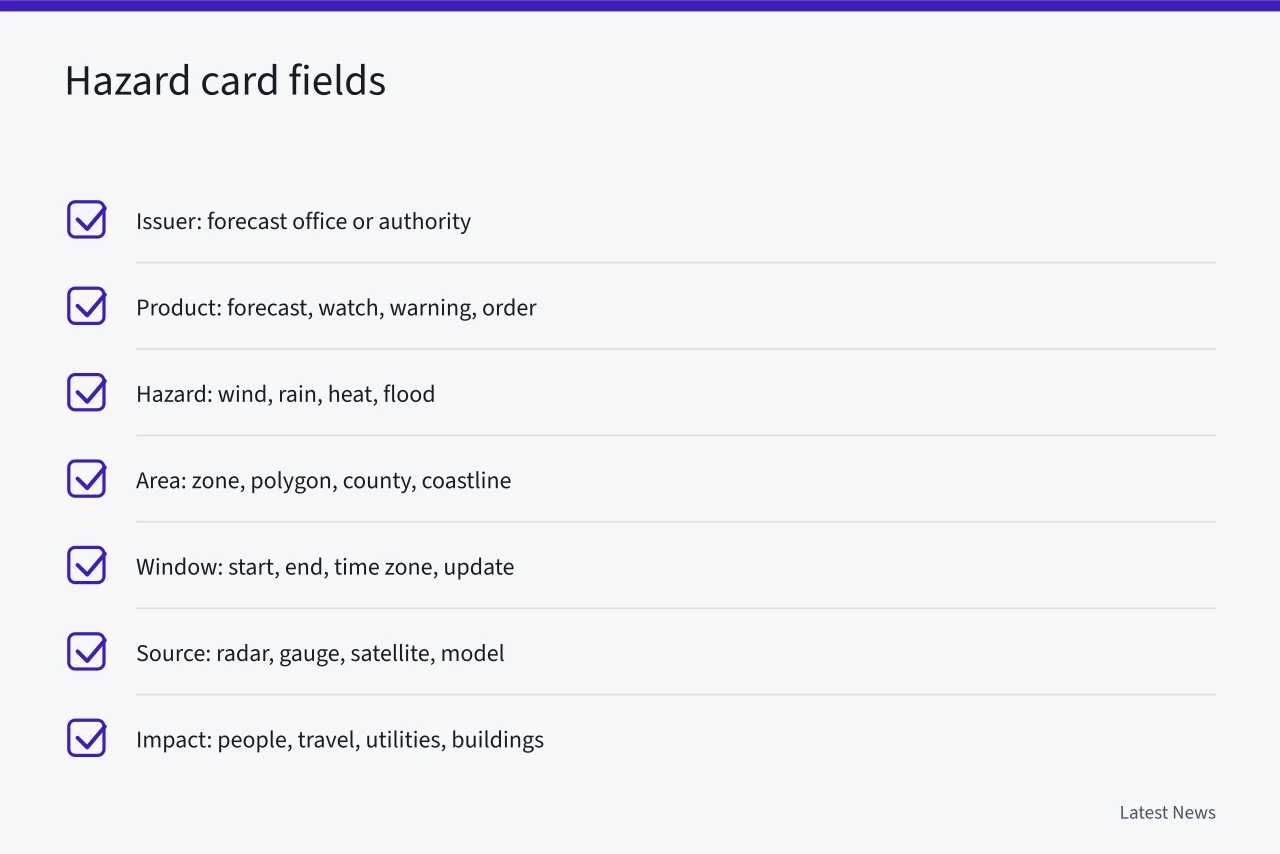
Build a hazard card
| Field | What to record |
|---|---|
| Issuer | Forecast office, emergency manager, geological agency, or other authority |
| Product | Forecast, outlook, watch, warning, statement, order, or bulletin |
| Hazard | Wind, rain, heat, fire, flood, quake, smoke, surge, or another event |
| Area | Exact zone, polygon, county, river reach, coastline, or facility |
| Window | Start, end, time zone, and next scheduled update |
| Source | Radar, gauge, satellite, model, spotter, sensor, or official report |
| Impact | Expected effects on people, travel, utilities, buildings, or services |
| Action | Official protective instruction and responsible authority |
Keep forecast confidence separate from possible severity. A low-probability outcome can be severe. A high chance of rain does not state how much rain will fall. Instruction-bearing coverage shares its rules with health desks; the health alerts and medical news guide is the parallel playbook.
Explain probabilities precisely
Probability, expected amount, and plausible range answer different questions. The National Weather Service's probabilistic precipitation portal presents an official expected amount alongside low-end and high-end amounts defined by stated chances over the next 72 hours. This supports reporting a range and its probability rather than turning one map value into a promise.
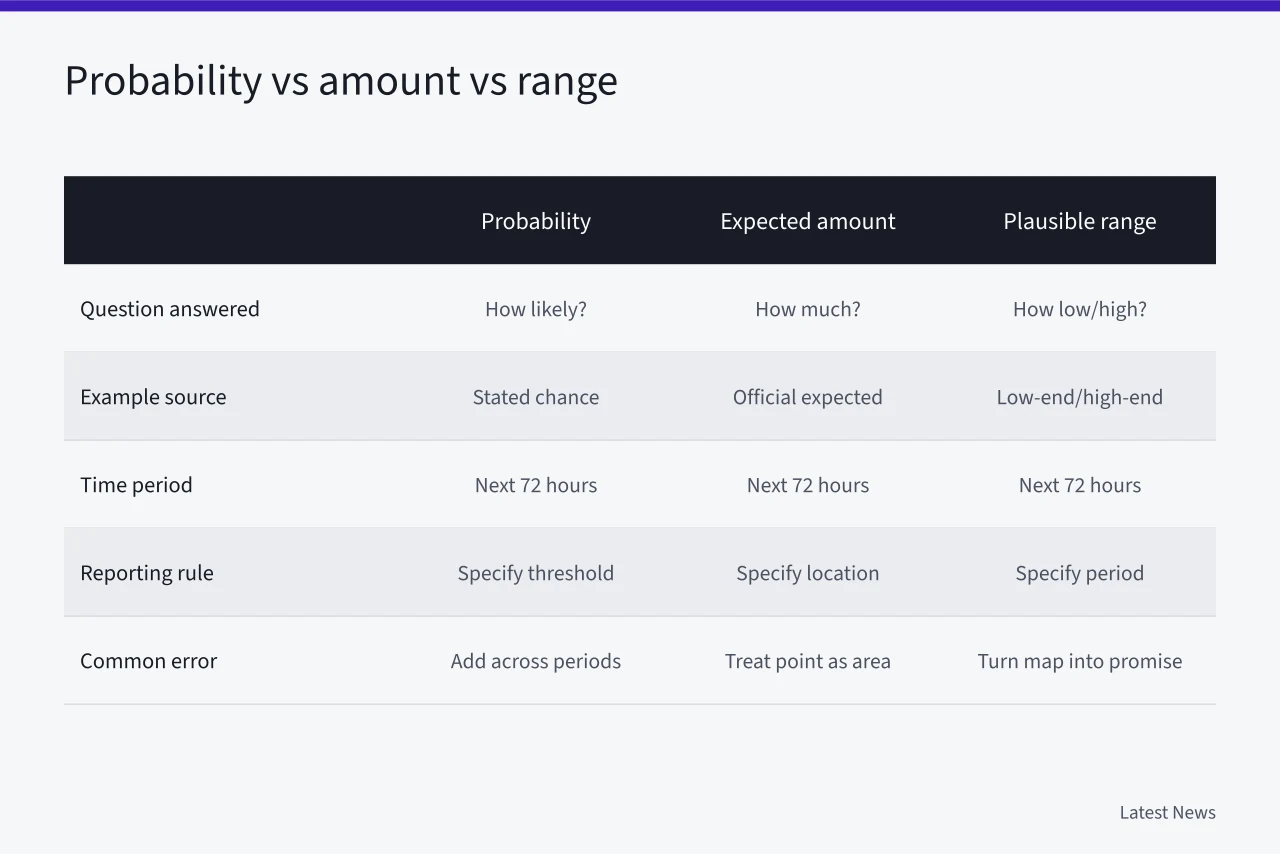
Specify the location, period, threshold, and event. Do not add probabilities across time periods or treat a point forecast as an area-wide guarantee.
Treat maps as data displays
Read the title, legend, timestamp, valid period, units, and geographic resolution. Check whether shading represents probability, category, accumulation, anomaly, intensity, or warning area. A boundary on a map may mark administrative responsibility rather than the physical edge of a hazard.
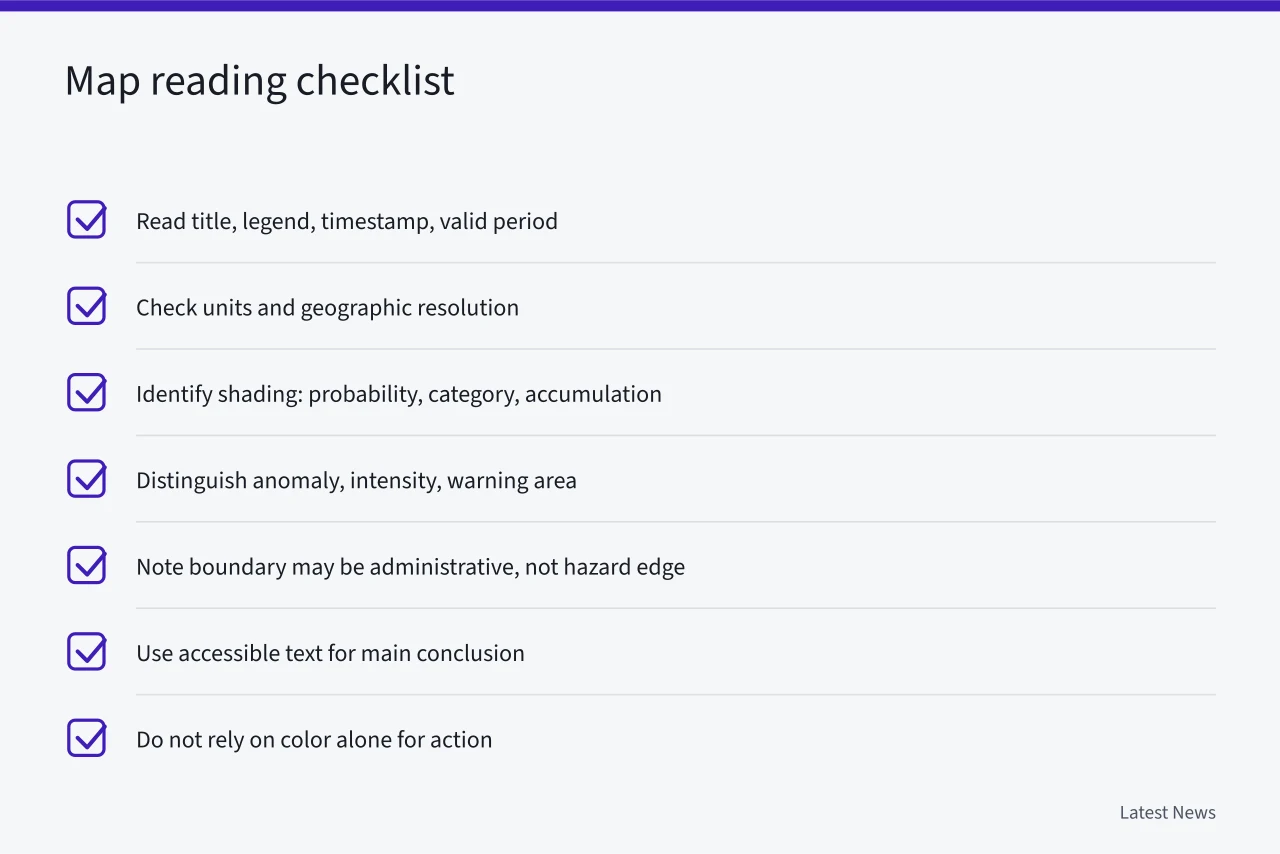
Use accessible text for the main conclusion. Readers should not need to distinguish colors to learn the action or timing.
Separate observation and forecast
Write "radar indicated," "a gauge measured," "officials reported," or "forecasters expect" as appropriate. Ground reports can confirm impacts that remote sensors suggest but do not directly see. Early measurements may change after quality control.
Do not crowdsource rescue locations or repeat unverified casualty numbers. Direct urgent reports to the authority named for that purpose. For a worked instruction-first drill, see the fictional food recall outbreak case.
Follow the alert lifecycle
A watch, warning, statement, evacuation order, and all-clear do not come from one universal system. Preserve the issuer's label and jurisdiction. Record when a product is expanded, extended, upgraded, replaced, canceled, or allowed to expire.
Product names carry defined meanings. The Baltimore/Washington forecast office's page of watch, warning, and advisory definitions lists each hazard and when each product is issued.
A winter storm watch, for example, means significant winter weather is possible within about 48 hours, not that it will occur. Check the issuing office's own definitions rather than assuming one hazard's rules transfer to another.
Update the headline, summary, map caption, action box, and social text together. An old instruction remains harmful even when a correction appears at the bottom. The health alert reporting checklist shows the same repair-everything rule applied to product notices.
Common questions
Is a forecast the same as a warning?
No. A forecast describes expected conditions. A warning is an official alert product with defined criteria and instructions.
Does 70 percent chance of rain mean rain for 70 percent of the day?
Not by itself. Report the issuing forecast's location, period, and probability definition.
Can radar confirm what is happening at street level?
Radar supplies remote observations with limits. Ground reports, gauges, and other sensors can be needed to confirm local impacts.
When is a weather story finished?
After the hazard and public instructions have ended, key impacts are confirmed, and corrections or later measurements are incorporated.