Guides
Federal vs Provincial Bill in Canada: Jurisdiction, Process, and Where to Watch
Federal vs provincial bill Canada: how sections 91 and 92 shape first reading, committee, royal assent, and where to watch each lawmaking process.
What to take away
- Federal and provincial bills follow similar stages, but jurisdiction comes from sections 91 and 92 of the Constitution Act, 1867.
- A federal bill needs the House of Commons and the Senate; a provincial bill needs only the elected legislature.
- Royal assent is required before a bill becomes law, but coming into force often waits for a separate commencement date.
- Where to watch differs: LEGISinfo for federal bills, each provincial legislature's site for provincial bills.
- Neither level can override the other's enumerated powers.
Canadian readers often mix up which level handles a policy. The answer starts with the constitutional division of powers under sections 91 and 92.
What is being compared
The two processes are the federal Parliament in Ottawa and a provincial legislature such as Ontario's Legislative Assembly. Every province has a unicameral legislature. Parliament has two chambers: the elected House of Commons and the appointed Senate.
Jurisdiction is the first filter. Section 91 lists federal powers, including criminal law, banking, postal service, and trade and commerce. Section 92 assigns provinces power over property and civil rights, hospitals, education, municipalities, and local works. Privacy and data rules can straddle both levels, as the guide for cross-border newsrooms explains.
The criteria that matter
To compare the two paths, check four things: constitutional source, chamber steps, royal assent and commencement, and public access to bill status. The table below sets out the side-by-side test.
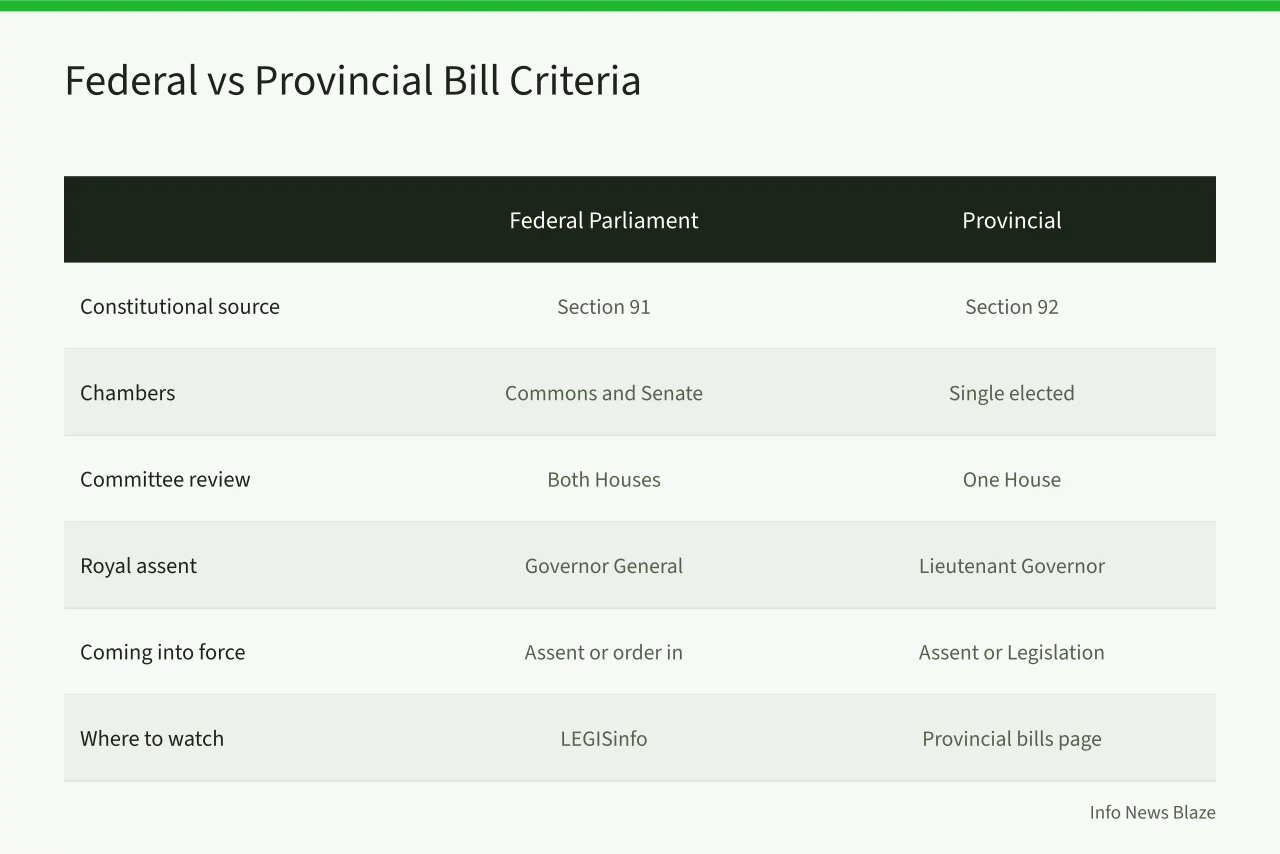
| Criterion | Federal Parliament | Provincial legislature |
|---|---|---|
| Constitutional source | Section 91, Constitution Act, 1867 | Section 92, Constitution Act, 1867 |
| Chambers | House of Commons and Senate | Single elected assembly |
| Committee review | Standing or special committees in both Houses | Legislative committee in the one House |
| Royal assent | Governor General | Lieutenant Governor |
| Coming into force | On assent or later by order in council or provision | On assent or later under provincial Legislation Act |
| Where to watch | LEGISinfo for bill text, votes and status | Provincial legislature site, e.g. Ontario's bills page |
Federal bill stages
A federal bill follows set steps in each chamber. The Senate can amend and return it, so the House may vote again.
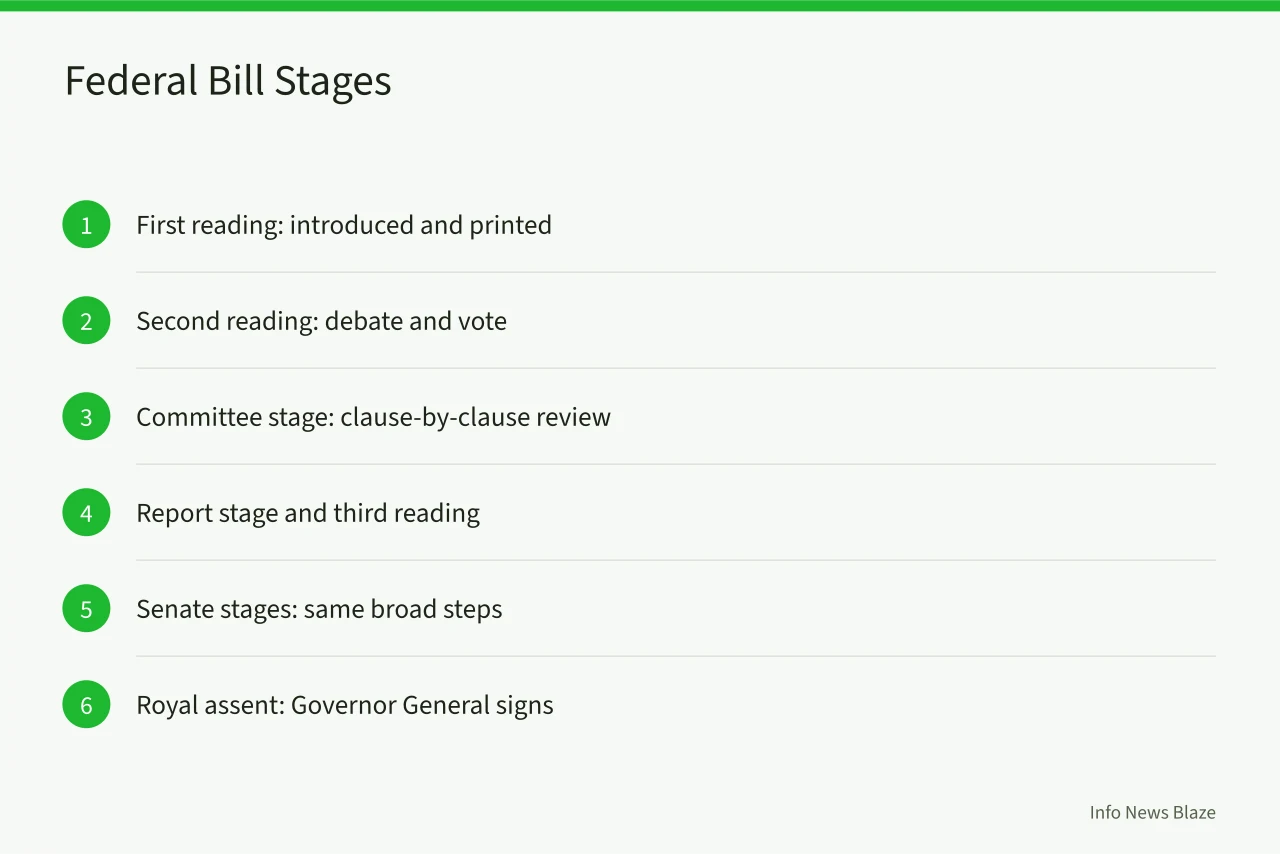
- First reading: the bill is introduced and printed, with no debate.
- Second reading: members debate the principle and vote.
- Committee stage: a committee reviews the bill clause by clause, hears witnesses, and reports amendments.
- Report stage and third reading: the House considers further amendments and holds a final vote.
- Senate stages: the bill goes through the same broad steps, then returns for any concurrence votes.
- Royal assent: the Governor General signs the bill, and it becomes an act.
A federal bill is not law after the House of Commons passes it. The Senate must also pass the same text before royal assent.
For a U.S. comparison, Track a Federal Bill explains status and committee steps south of the border.
Provincial bill stages
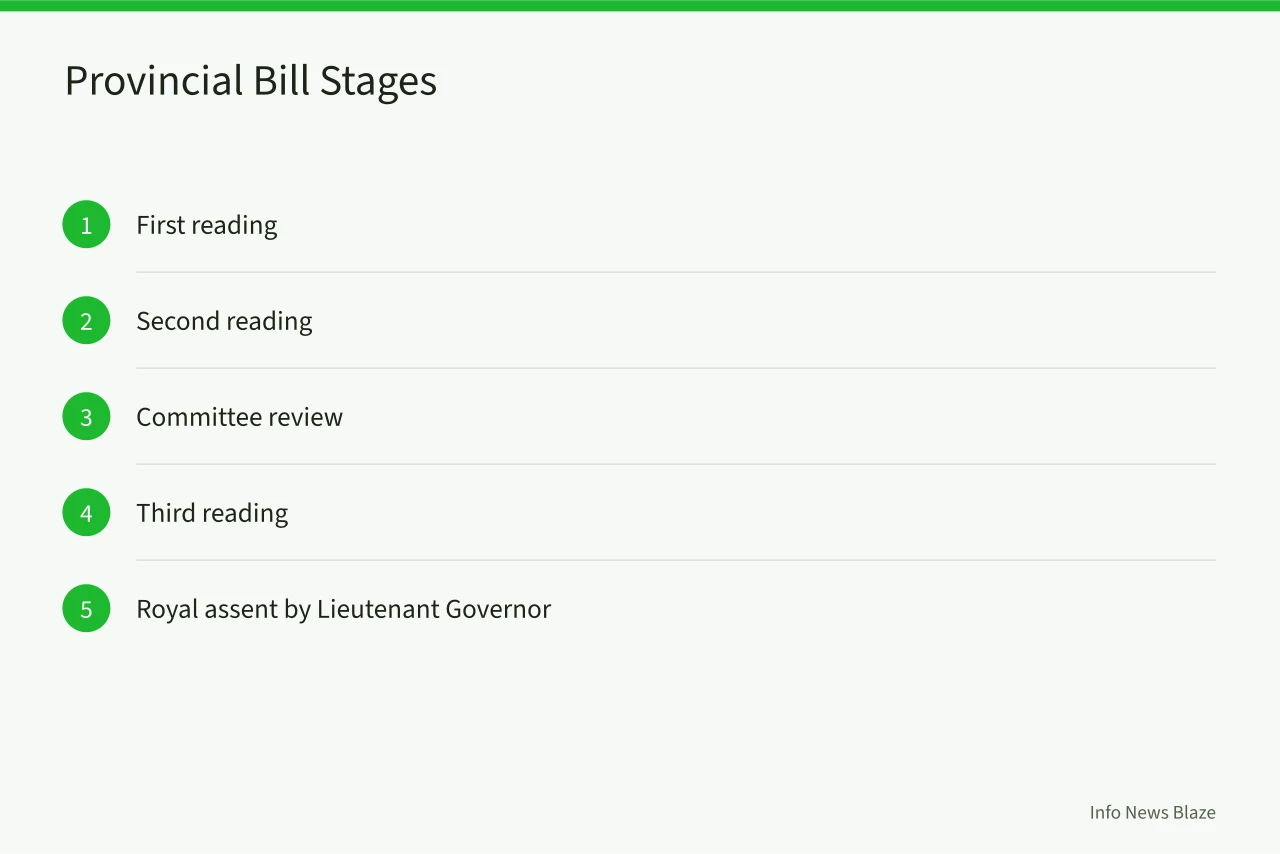
Provincial bills are simpler in one way: there is no Senate. Ontario's Legislative Assembly follows first reading, second reading, committee, third reading, then royal assent by the Lieutenant Governor. Committee reviews are often shorter than federal ones, but clause-by-clause work still applies.
Ontario's Legislation Act sets out publication and commencement rules for provincial bills and regulations. For example, it addresses when an act or regulation takes effect if the bill does not say. The Ontario Legislation Act is the primary provincial reference.
Where to watch federal and provincial bills
For federal bills, use LEGISinfo. It lists versions, sponsor, votes, committee meetings, and whether the bill received royal assent. For provincial bills, each legislature maintains a bills page. Examples include Ontario, British Columbia, and Alberta. Provincial sites vary in how much history they expose.
- Check LEGISinfo for the current bill text and stage.
- Check the provincial legislature's bills page for first reading to royal assent.
- Check the relevant provincial gazette for commencement dates.
If you want internal records behind a bill, the Access to Information Request guide covers timelines, fees, and appeals.
Where each one wins
A federal bill is the right route when the subject falls under a section 91 head of power. To amend the Criminal Code, set bank rules, or change federal elections law, you must start in Parliament. A provincial bill is the right route for property, municipal government, hospitals, or school boards. To change a province's landlord-tenant rules or municipal election dates, the bill goes through the provincial legislature.
What none of them solve
Both processes share a limitation. Royal assent does not mean a rule is in force. An act can sit unproclaimed for years, and the actual obligations may appear later in regulations. The compliance date article explains why the date that mattered may not be the date the bill passed.
Another shared limitation is that neither level can settle a dispute about its own power. If a province passes a law touching a federal head of power, or Parliament touches a provincial area, a court decides whether the law is valid.
Common questions
Which level handles health care? Health is provincial under section 92, but the federal government influences it through spending power and criminal law powers.
Does a provincial bill need Senate approval? No. Provinces have no Senate; royal assent is given by the Lieutenant Governor.
Where can I read a federal bill? Use LEGISinfo for bill text, versions, amendments, and status in both chambers.
How can I see internal analysis behind a bill? File an access request under the federal Access to Information Act. The overview on Canada.ca covers how to request, fees, and appeal options.