Guides
Institutional claims guide: matching expertise to the actual claim
Institutional claims and attribution guide covering source roles, documents, spokesperson authority, expert fit, conflicts, evidence, quotations, and corrections.
What to take away
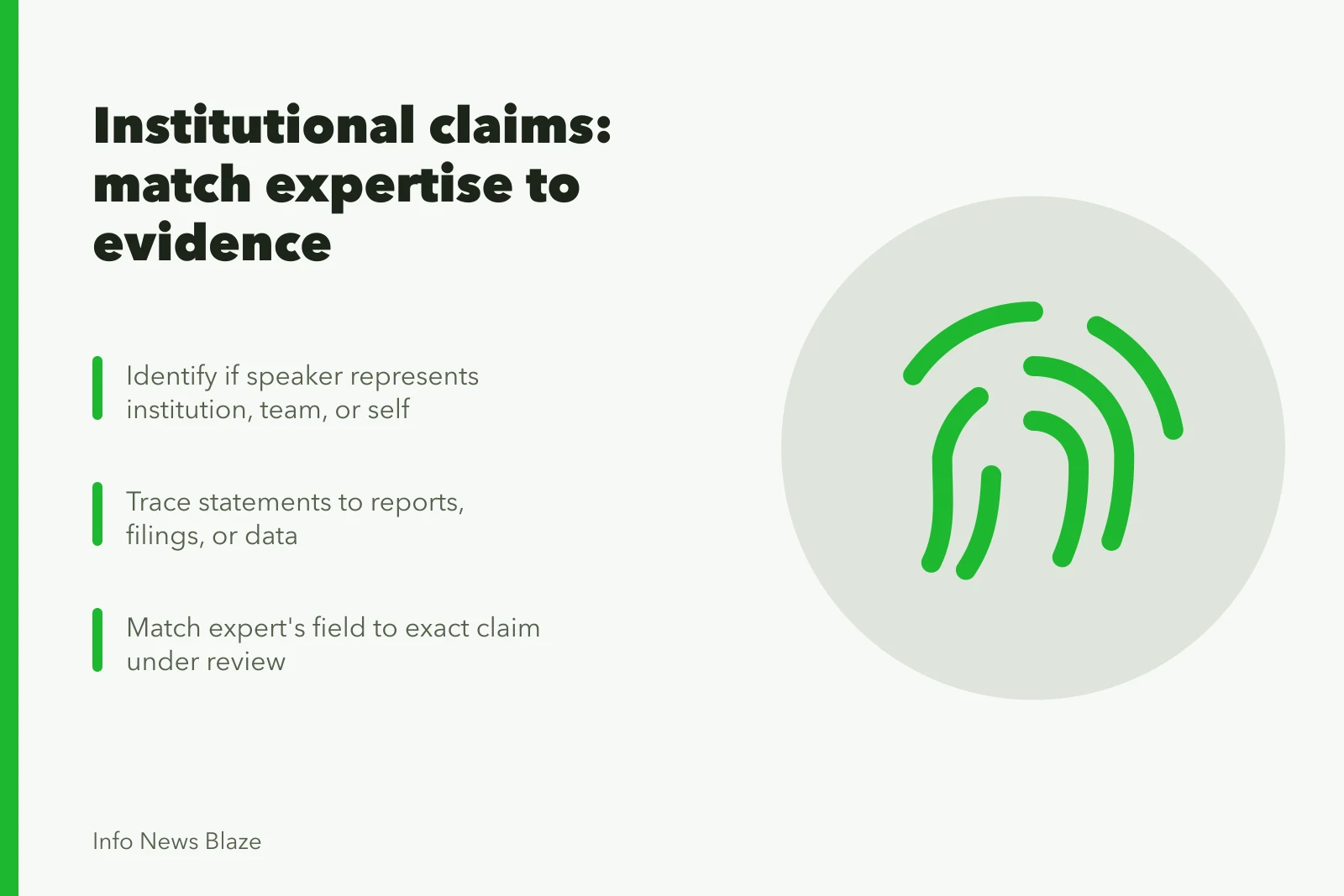
- Identify whether a person speaks for an institution, a team, or only themselves.
- Trace a public statement to the document or evidence behind it.
- Match an expert's field to the exact claim under review.
- Disclose relevant interests without treating disclosure as proof of falsehood.
- Place attribution where the claim appears.
An institution can issue a press release, publish a report, file a legal document, hold a briefing, and make data available on the same subject. These records do not carry the same evidentiary weight. The newsroom needs to identify who created each one, for what purpose, under which review process, and with what authority.
Photo and credit
The image shows microphones awaiting speakers. It does not identify a source, confirm a claim, or illustrate an event described in this guide.
Build a source identity card
| Field | Reporting question |
|---|---|
| Person | Who made the statement? |
| Role | Employee, spokesperson, author, contractor, adviser, witness, or outside expert? |
| Authority | Can this person state the institution's position? |
| Claim | What exact sentence needs support? |
| Record | Which report, data table, filing, order, or observation supports it? |
| Review | Editorial, legal, peer, audit, committee, or no stated review? |
| Interest | What financial, professional, legal, political, or personal relationship is relevant? |
| Time | When was the claim made, and has it been revised? |
A title may establish employment without establishing authority over the claim. Ask whether the speaker represents the institution, comments in a personal capacity, or interprets work produced by someone else. The same voice separation runs through court documents compared, where each filing speaks for its author.
Source identity card fields
- Personwho made the statement?
- Roleemployee, spokesperson, author, contractor?
- Authoritycan they state the position?
- Claimwhich exact sentence needs support?
- Recordwhich report, filing, or data?
- Revieweditorial, legal, peer, audit?
- Interestfinancial, legal, political, personal ties?
Separate statement, evidence, and conclusion
Write three lines in the notes:
Separate statement, evidence, conclusion
- Writethe institution says...
- Writethe cited record shows...
- Writethe newsroom can conclude...
- Compare the three lines for gaps
- Narrow the claim to fit the record
- The institution says...
- The cited record shows...
- The newsroom can conclude...
The three lines may differ. A report can contain data that support a narrower claim than its executive summary. A complaint records allegations, not a judgment. A company filing records the company's disclosure, not outside confirmation of every assertion. Document-by-document limits are mapped in the official record types comparison.
Inspect the production chain
Production chain inspection
- Authors and contributors
- Funders and data source
- Methods and review process
- Approving office for release
- Corrections and version history
- Dissent or limitations outside summary
NIST's information quality standards define agency expectations around utility, objectivity, and integrity. The page also describes transparency about data, assumptions, methods, and statistical procedures as part of reproducibility. These are NIST's standards and legal framework, not a universal certification for every institutional report, but the fields form a useful reporting check.
Match expertise to the claim
"Scientist," "doctor," "lawyer," and "economist" are broad labels. A specialist can explain one portion of a story while lacking direct expertise in another. Check education, current work, publications, methods experience, licenses where relevant, and the person's role in the underlying issue.
Ask the expert to mark the boundary of their competence. A clear refusal to answer outside it can make the remaining comment more useful.
Courts apply the same discipline to expert testimony. Cornell's Legal Information Institute entry on the Daubert standard says the standard makes trial judges gatekeepers of expert evidence and requires them to scrutinize the expert's methodology and underlying principles. A newsroom is not a court, but the order of scrutiny transfers.
Report interests in context
An interest can include funding, employment, consulting, patents, investments, advocacy, testimony, litigation, institutional ties, or a public position. Relevance depends on the subject and time period.
Disclosure is context, not a verdict. Explain the relationship and let readers see why it could matter. Do not use a generic "no conflicts" label unless the scope and declaration process are known. The conflicts section of the health and science claim checklist turns this into fixed questions.
Attribute close to the claim
Readers should not have to reach the end of a paragraph to learn that a disputed fact came from one party. Name the source in the same sentence or immediately before it. Repeat attribution when a long passage could otherwise adopt the claim as the newsroom's voice. Placement rules match developing news stories: attribution sits where the claim appears.
Avoid empty formulas such as "officials say" when the office and document are available. Name the unit, speaker, report date, and status.
Build the correction route
Save the source version and contact. Schedule a check for amended reports, corrected data, changed spokesperson statements, legal outcomes, and disclosed interests. If the source withdraws a claim, verify why and update the article's conclusion, not only its attribution.
Common questions
Is an official statement a verified fact?
It verifies what the institution said. Claims about events, results, causes, or other people may need separate evidence.
Can an institution speak through an unnamed spokesperson?
Yes, under a newsroom's sourcing rules, but the article should describe the person's authority and why anonymity is justified.
Does a conflict of interest disqualify an expert?
Not automatically. The relationship may require disclosure, management, another source, or exclusion depending on its relevance and the decision involved.
How much attribution is enough?
Enough that readers can distinguish the newsroom's verified facts from claims, analysis, opinion, and allegations throughout the article.