Reviews
Part of Disaster, emergency, and conflict reporting: a practical guide for 2027
Watches vs warnings vs orders, with emergency alerts compared plainly
Emergency information types compared across forecasts, watches, warnings, orders, observations, incident reports, damage estimates, and casualty records.
What to take away
- Watches vs warnings vs orders are different records. A Tornado Watch is not a Tornado Warning, and a warning is not a mandatory evacuation order.
- The issuing institution defines the meaning of its own product. The National Weather Service, NOAA National Hurricane Center, FEMA, USGS, and local emergency managers use different labels and criteria.
- Named products include Tornado Watch, Tornado Warning, Flash Flood Warning, Hurricane Warning, Wireless Emergency Alerts, USGS ShakeAlert, and AMBER Alert.
- Hazard size and experienced effect may use different measurements.
- Early damage and casualty figures need definitions and cutoff times.
- A repeated claim does not become an independent confirmation.
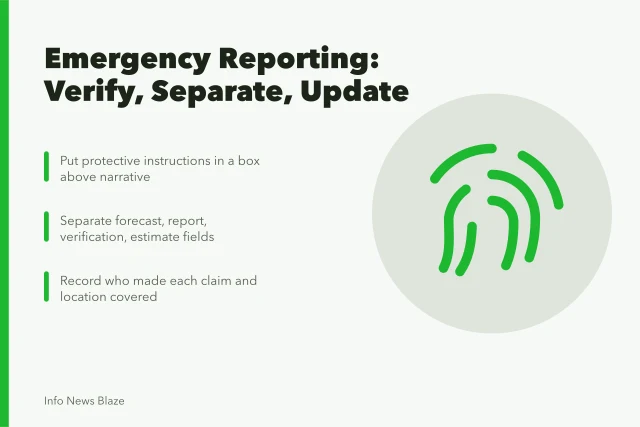
Breaking coverage often places unlike information in one stream. A predicted storm track sits beside a mandatory order, a witness video, and an early damage estimate. A comparison table keeps their status visible. The full coverage method is set out in the disaster and emergency reporting guide.
Information comparison
Emergency information types
Type
- Forecast
- future conditions
- Watch
- elevated potential
- Warning
- hazard imminent
- Order
- authorized direction
- Observation
- sensor or human report
- Incident report
- submitted account
- Damage estimate
- preliminary loss
- Casualty record
- death or injury
Records
- Forecast
- What may happen?
- Watch
- What to prepare for?
- Warning
- Who acts now?
- Order
- What action required?
- Observation
- What was detected?
- Incident report
- What is reported?
- Damage estimate
- What scale estimated?
- Casualty record
- Who meets criteria?
Main question
- Forecast
- written as observed
- Watch
- treated as warning
- Warning
- detached from area
- Order
- paraphrased as advice
- Observation
- generalized across region
- Incident report
- called verified
- Damage estimate
- mixed with destroyed
- Casualty record
- totals added across sources
Common error
- Forecast
- Watch
- Warning
- Order
- Observation
- Incident report
- Damage estimate
- Casualty record
| Type | What it records | Main question | Common reporting error |
|---|---|---|---|
| National Hurricane Center track forecast | Expected future conditions from NOAA National Hurricane Center | What may happen? | Written as an observed outcome |
| Tornado Watch (NWS) | Elevated potential under the issuer's system; NWS issues when conditions are favorable for tornadoes, often for several hours | What should people prepare for? | Treated as a warning |
| Tornado Warning (NWS) | Hazard occurring, imminent, or likely under stated criteria; a tornado is radar-indicated or sighted | Who should act now? | Detached from area and time |
| Mandatory evacuation order (local emergency management) | Direction from an authorized body, often by zone | What action is required? | Paraphrased into weaker advice |
| Radar-indicated rotation or trained spotter report (NWS) | Sensor or human report | What was detected at a place and time? | Generalized across the region |
| 911 call or police incident report | Submitted account | What has been reported? | Called verified without checks |
| FEMA Preliminary Damage Assessment | Preliminary or assessed loss under a method | What scale of damage is estimated? | Mixed with destroyed structures |
| Medical examiner or coroner fatality count | Death or injury under inclusion rules | Who meets the stated criteria? | Totals added across overlapping sources |
| Flash Flood Warning (NWS) | Flash flooding occurring or imminent under NWS criteria | Who should act now? | Detached from area and time |
| Severe Thunderstorm Warning (NWS) | Severe thunderstorm occurring or imminent; winds at least 58 mph or hail at least 1 inch | Who should act now? | Detached from area and time |
| Hurricane Warning (NOAA National Hurricane Center) | Hurricane conditions expected, usually issued about 36 hours before onset | Who should act now? | Detached from area and time |
| Wireless Emergency Alerts (FEMA IPAWS) | Short cell phone message for imminent threats, AMBER Alerts, and presidential messages | What action is required? | Treated as a forecast |
| USGS ShakeAlert | Earthquake early warning for the West Coast from USGS and partner networks | What action is required? | Treated as a prediction |
| AMBER Alert (DOJ and state plans) | Child abduction alert under state criteria | What action is required? | Treated as proof of a crime |
| NOAA Weather Radio All Hazards (NWS) | Continuous broadcasts with tone-activated receivers | What should people prepare for? | Treated as a general forecast |
Watch, warning, and advisory
The National Weather Service explanation of watch, warning, and advisory terms says a watch signals that hazardous weather is possible with uncertainty about occurrence, place, or time. It says a warning covers a threatening event that is occurring, imminent, or likely. An advisory covers less serious conditions that can still cause significant inconvenience or danger without caution.
In practice, a Tornado Watch from the NWS means conditions favor tornadoes in and near the watch area, often for several hours. A Tornado Warning means a tornado is indicated by radar or has been sighted. A Flash Flood Warning means flash flooding is occurring or imminent.
The National Hurricane Center uses separate labels. A Hurricane Watch means hurricane conditions are possible, usually issued about 48 hours before tropical-storm-force winds arrive. A Hurricane Warning means hurricane conditions are expected, usually issued about 36 hours before onset.
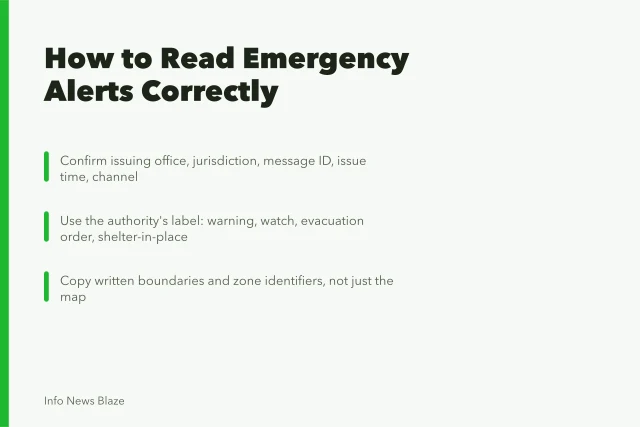
Those are NWS and NHC terms. Other alerting systems and jurisdictions may use different labels or thresholds. Preserve the product name, location, issue time, and action language.
Forecast and observation
A forecast uses data and models to estimate future conditions. The National Hurricane Center track forecast is a forecast, not an observation. An observation records a sensor reading or report at a particular place and time.
Radar-indicated rotation, a trained spotter report, and a confirmed damage survey are related but distinct. Write "forecast," "estimated," "measured," "reported," or "observed" where the status changes interpretation. Those labels behave like the evidence states in developing news stories.
Hazard measure and local effect
One event can have a single source measure and many local effects. An earthquake is a useful example. The U.S. Geological Survey explains the difference between earthquake magnitude and intensity: magnitude measures earthquake size at its source, while intensity measures shaking at a location and varies across the affected area.
USGS ShakeAlert uses seismic networks to send earthquake early warnings for the West Coast. It estimates expected shaking, not a precise prediction of damage at every address. The same discipline applies beyond earthquakes.
Wind speed does not equal building damage. Rainfall total does not equal flood depth at every site. Hazard characteristics and observed consequences belong in different fields.
Report and verification
A report can come from a witness, hospital, or police unit. It can also come from a military party, aid group, sensor network, or social account. A 911 call and a police incident report are submitted accounts. They are not verified impact by default.
Verification requires the publisher to meet a stated standard, such as direct contact, records, geolocation, multiple independent sources, or physical inspection. Several outlets citing the same official statement are one source chain. Several accounts copying one video are one item of evidence.
Estimate and assessed count
An early estimate may use sampling, modeling, aerial review, administrative records, or partial field checks. The FEMA Preliminary Damage Assessment is one example. An assessed count may still change as access improves and duplicates are removed.
Report the unit and classification. "Homes affected" may include minor damage, while "homes destroyed" uses a narrower threshold. "People displaced" may be a modeled population, registrations at shelters, or individuals verified away from home. When those labels blur, the result is the missing-denominator problem cataloged in statistics reporting problems.
Casualty count and named record
A headline total may aggregate confirmed deaths, unidentified deaths, and reported deaths. It may also mix civilian, military, direct, and indirect deaths under one source's rules. Another source may use different rules and cutoff times. A medical examiner or coroner count often uses local jurisdiction rules.
Do not combine them unless the records can be deduplicated and their definitions align. Attribute totals and explain material exclusions. Reading the alert products themselves is covered in how to read an emergency alert.
Common questions
What is the difference between a watch, a warning, and an order?
A Tornado Watch means conditions favor tornadoes. A Tornado Warning means a tornado is indicated or sighted. A mandatory evacuation order comes from an authorized local body and states required action.
Is a warning proof that damage occurred?
No. It communicates a hazard under the issuer's criteria. Damage needs observation or assessment.
Can two correct casualty totals differ?
Yes. They may use different inclusion rules, source access, areas, periods, or verification thresholds.
Is a map model an observation?
Not unless it displays observed data. Read the legend and metadata for modeled, forecast, estimated, or measured layers.
When does an estimate become final?
That depends on the producer's process. Use its version labels and explain the remaining revision path.