Reviews
Part of Institutional claims guide: matching expertise to the actual claim
Source materials, ranked: from press releases to sworn testimony
Source materials ranked from weakest to strongest, from press releases and statements up to sworn testimony, with what each can prove on its own.
What to take away
- Source materials, ranked from press releases to sworn testimony, differ by what one item can establish alone, not by how official it looks.
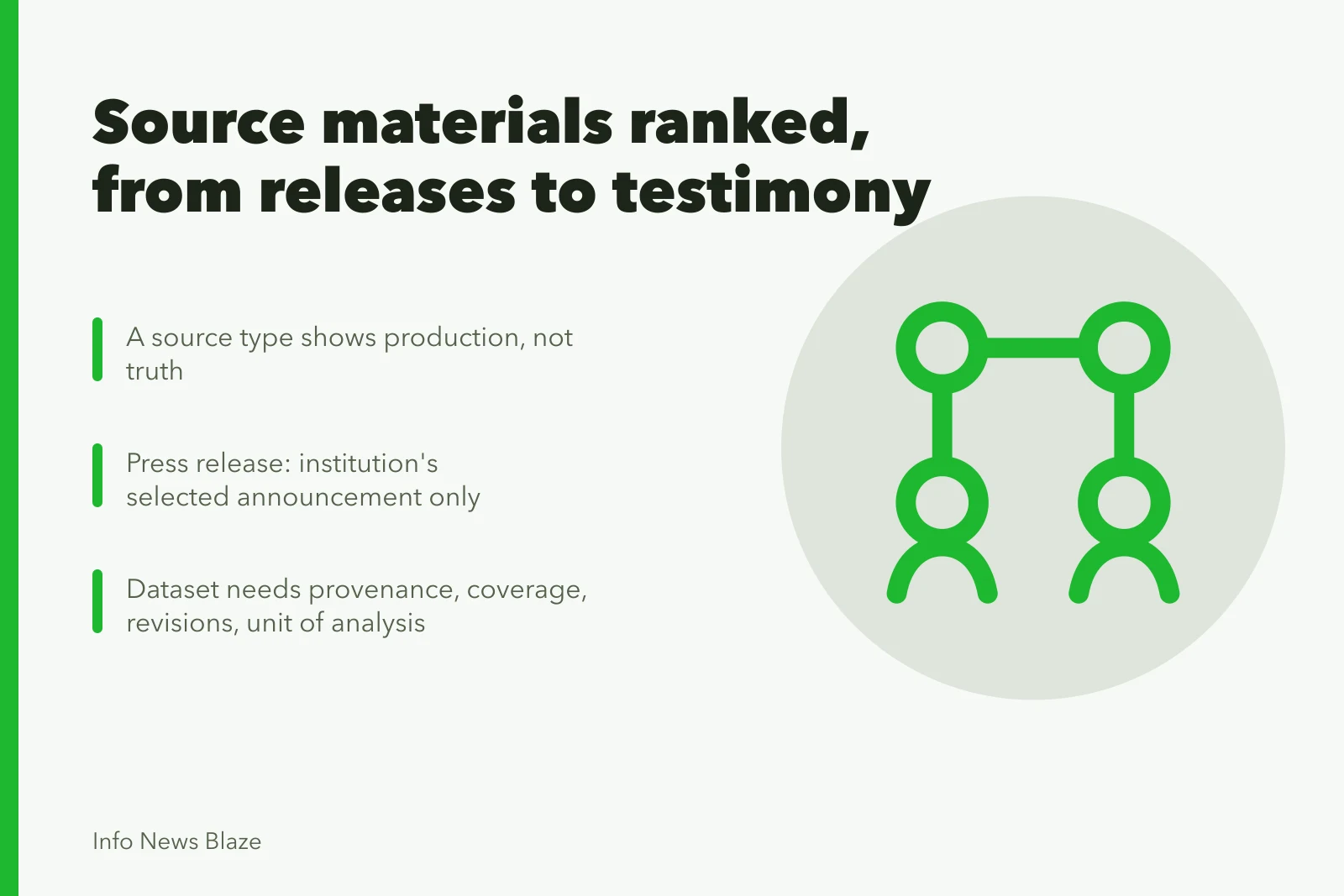
- A press release proves an institution said something. It never proves the claim is true.
- A dataset proves the values inside its own definitions and coverage, nothing wider.
- A filing proves a document exists and carries a date. A complaint remains an allegation.
- Sworn testimony proves a witness said it under oath. It does not prove the content is accurate.
Newsrooms use "source" for people, documents, datasets, recordings, and institutions. That shorthand hides the question that matters: what can this item establish on its own? For the people side, the institutional claims and attribution guide supplies the identity card.
The ranking: nine source types, weakest to strongest
Ranked by what a single item proves without a second source behind it. Real examples below show where each type lives and what it can carry.
- Press release.The institution's selected announcement. Proves the institution announced it. Apple posts investor news at investor.apple.com, and PR Newswire and Business Wire distribute releases for many companies. Retrieve the underlying order, filing, study, or contract before repeating any number.
- Public statement.What a speaker said at a time. A White House briefing transcript on whitehouse.gov or a C-SPAN clip records the words. Record the speaker's authority and whether remarks were prepared, spontaneous, or corrected later.
- Interview.A source's account and explanation. NPR's Fresh Air posts transcripts, and 60 Minutes publishes segments and transcripts. An interview gives you a chance to test claims and ask for documents. It does not turn an answer into confirmation.
- Official record.Information recorded under a process. A Federal Register notice, a county clerk's deed, or city council minutes can place a person, office, or transaction in a documented chain. It can still carry an error, an omission, or a self-serving account.
- Regulatory filing.A required disclosure by the filing party. SEC Form 10-K, Form 8-K, and Form S-1 filings sit on EDGAR; the FEC posts campaign finance filings. A complaint contains allegations; an answer responds to them; an order records a court's direction. Name the document type in the same sentence as the claim.
- Dataset.Values under stated fields and collection rules. The Census Bureau's American Community Survey publishes one-year and five-year estimates; the Bureau of Labor Statistics releases the Consumer Price Index monthly. A dataset needs definitions, provenance, collection dates, and coverage. It also needs missing-data handling, revisions, and a unit of analysis.
- Audit report.Findings under a stated scope and standards. GAO reports follow the Yellow Book, and agency inspectors general publish audits under their own standards. The engagement defines what was examined, so it says nothing about matters outside it.
- Research paper.Authors' methods, results, and interpretation. PubMed indexes papers from the National Library of Medicine, and medRxiv posts preprints. Use the paper to explain method and claim, and seek another route for facts it does not contain.
- Sworn testimony.A witness's words and materials entered under oath, with a transcript and exhibits. Congress.gov posts hearing transcripts, and federal court depositions appear in PACER. It is the strongest record of what was said, and still not a finding of fact.
The order shifts with the question. A careful synthesis can explain context one original record cannot. What the ranking fixes is the floor: each item proves at least the thing in its row, and no more.
Statements and releases
A statement may set policy, answer a question, defend an action, or announce an event. A release is useful for the institution's position, contacts, and links. It is not a finding, and its numbers need the underlying record. Retrieval routes are the business of public records reporting.
Records and primary material
An original record can place a person, office, or transaction in a documented process. It can still contain an error, an omission, or unclear terminology.
Document Analysis Steps
- Meet the document
- Observe its parts
- Make sense of it
- Use it as evidence
The National Archives guide to document analysis treats meeting the document, observing its parts, making sense of it, and using it as evidence as separate steps. That framework supports checking creator, date, audience, form, and context rather than assuming "primary" means self-explanatory.
Data and studies
Use the dataset to support the calculation it can reproduce. A study adds a research question, method, comparison, analysis, and interpretation. Study reading gets its own sequence in how to read a study or preprint.
Filings and legal material
A filing can create a dated record and a legal obligation, and its status matters. A regulatory filing may be amended, which changes what the current version says. The court docket desk case turns one mixed docket line into a corrected story.
Audits and reviews
An audit report should identify the engagement type, scope, criteria, and period. It should also identify the evidence, findings, and limitations. A review, inspection, assessment, or evaluation may follow other standards.
Audit Report Checklist
- Engagement type
- Scope
- Criteria
- Period
- Evidence
- Findings
- Limitations
The Government Accountability Office page for Government Auditing Standards says the Yellow Book contains standards for financial audits, attestation engagements, and performance audits, plus requirements for auditors and audit organizations. The label "audit" is useful only with the standards and scope that govern the actual report.
Testimony and interviews
Testimony can be sworn or unsworn, prepared or oral, public or sealed. Retrieve the transcript, written statement, exhibits, questions, and later corrections. A witness may speak from direct knowledge, expert analysis, institutional authority, or advocacy. State which.
Common questions
Is a primary source better than a secondary source?
It is closer to a person, event, or process, but "better" depends on the question. A careful synthesis may explain context that one original record cannot.
Does an audit prove that no other problem exists?
No. Read the scope, criteria, sampling, period, and limitations. An audit addresses its engagement, not every possible issue.
Can a press release be cited?
Yes, for what the institution announced. Use the underlying record for claims that depend on methods, numbers, legal effect, or outside events.
What does testimony prove?
It proves that the witness gave the recorded statement. The factual content needs evaluation against evidence and the proceeding's later findings.