Rules
Part of Disaster, emergency, and conflict reporting: a practical guide for 2027
Why repetition during a crisis can look like confirmation
Crisis reporting problems explained with fixes for recycled images, duplicate counts, stale orders, false precision, rumor loops, unsafe disclosure, and updates.
What to take away
- Trace viral material to its origin before repeating it.
- Do not add totals that may describe the same people or damage.
- Replace stale safety instructions as soon as a new order arrives.
- Use ranges and status labels when the evidence is incomplete.
- Keep a public note when a correction changes meaning.
Deadline pressure rewards short answers before the evidence can support them. The solution is not vague language. It is a disciplined record of source, status, place, time, definition, and revision.
Problem: repetition looks like confirmation
Ten accounts share the same video and caption. A roundup describes "multiple reports," although every post descends from one upload.
Trace the source chain
- Ten accounts share one video
- Roundup says multiple reports
- All posts descend from one upload
- Count independent evidence routes
- Preserve earliest known file
- Verify location, time, context
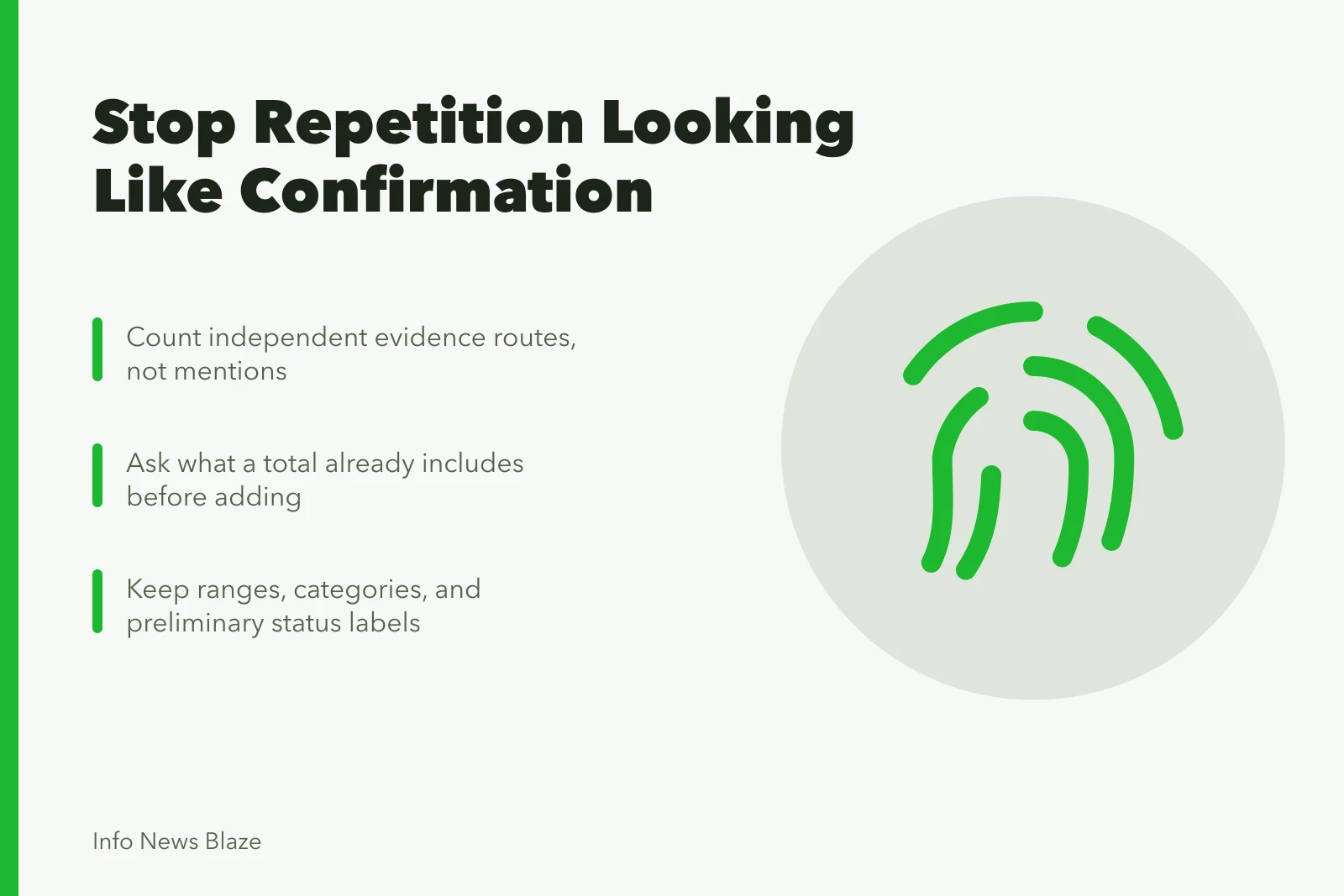
Fix: draw the source chain. Count independent evidence routes, not mentions. Preserve the earliest known file and ask what evidence confirms its location, time, and context. Chain drawing is a standing section of the emergency reporting checklist.
Problem: rumor response amplifies the rumor
A newsroom repeats a false claim in a headline before giving the correction. Readers who see only the headline retain the false statement.
Headline order matters
Rumor-first headline
- Opening
- Repeats false claim
- Reader takeaway
- Retains false statement
- False claim
- Amplified
- Link
- None
Fact-first headline
- Opening
- Leads with verified fact
- Reader takeaway
- Retains correction
- False claim
- Named only as needed
- Link
- Authority's correction
Fix: Lead with the verified fact and name the false claim only as needed. Link to the responsible authority's specific correction. FEMA's Hurricane Helene rumor-response announcement says false information can confuse survivors and impede access to help. It describes directing people to a dedicated source of corrections.
Its individual examples are tied to that response and should not be reused as current facts.
Problem: local totals are added to a national total
A national count already incorporates provincial or city reports, yet the article adds them again. The resulting figure has no defensible denominator.
Can you add these totals?
Does the national total already include the local figure?
Do not add; use one total
Present separate sources with overlap noted
Fix: ask each producer which lower-level figures it includes and the cutoff time. Use one total or present separate, clearly overlapping sources without addition. The disaster and emergency reporting guide makes the same rule a standing step: ask what a total already includes before adding to it.
Problem: a range becomes an exact number
An official says 20 to 30 structures may be damaged. The headline says 25 structures were destroyed. The midpoint was invented, and "damaged" became "destroyed."
Fix: retain the range, category, source, and preliminary status. Update after an assessment uses stated classifications. The forecast-to-assessed ladder is mapped in the emergency information comparison.
Problem: the map lacks metadata
A dramatic red layer circulates without a title, date, legend, scale, or source. The desk treats it as an observed impact map.
Fix: refuse the inference until the layer is identified.
Federal Geographic Data Committee's geospatial metadata overview compares a metadata record to a library catalog entry. It documents a data resource's who, what, when, where, and how, and explains why. It also says geospatial metadata describes maps and imagery among other location-based resources, and a screenshot without it is not enough.
Problem: old orders remain searchable
An evacuation ends, but the original headline and social card still tell people to leave. A new update exists only at the bottom of a long live page.
Fix: replace the action box, headline, and social copy. Add a prominent time-stamped note. Keep the old order in an archive that cannot be mistaken for the current instruction. Retiring old instructions cleanly is Step 8 of reading an emergency alert.
Problem: access limits become conclusions
Reporters cannot reach a site, so the story says damage is either catastrophic or fabricated. Neither follows from absence of access.
Fix: state who controls access, which checks remain impossible, what remote evidence exists, and what would resolve the claim.
Problem: publishing creates a new risk
A photo reveals the entrance to a shelter for threatened witnesses. A live shot shows a tactical position or rescue staging route. A document exposes phone numbers and medical details.
Fix: conduct a harm review before publication. Crop, blur, delay, generalize, or withhold when the public benefit does not outweigh the operational or personal risk. Tell readers when an image was materially altered for safety.
Problem: updates erase accountability
A false casualty total disappears from the live page without a note. Readers cannot tell which claim changed or whether an alert they saw was wrong.
Fix: preserve a correction log with the earlier claim, corrected claim, time, source, and affected distribution channels.
Common questions
Should a newsroom debunk every viral claim?
No. Prioritize claims that are spreading, affect safety or access to aid, or are being repeated by influential sources. Avoid giving a fringe claim a larger audience.
Can one official source confirm a road closure?
The responsible road or emergency authority may be sufficient for its own current order. Independent observation may still be useful when conditions change quickly.
What is false precision?
It is a level of numerical or geographic exactness the evidence does not support, such as inventing a midpoint or drawing a sharp boundary from a rough estimate.
When should an image be delayed?
Delay it when immediate publication could expose people, operations, routes, or vulnerable locations and the public benefit does not require live disclosure.