Rules
Part of Science reporting guides work best when evidence and advice stay separate
Science and health reporting problems and practical fixes in 2027
Science and health reporting problems explained with fixes for release-driven claims, weak comparisons, causal language, expert conflicts, and false certainty.
What to take away
- Replace release language with wording supported by the paper.
- Check the comparison behind every effect claim.
- Put study status and population near the first result.
- Review an expert's relevant field and interests.
- Correct the public claim when the evidence changes.
Many science-news errors are not arithmetic mistakes. They happen when a reporter changes the type of claim while compressing it: association becomes cause, a selected sample becomes "people," a laboratory response becomes a treatment, or a modeled scenario becomes a forecast.
The fixes below focus on the sentence readers receive, not just the research notes behind it.
Problem: the release becomes the evidence
A news release selects findings, quotes, and framing for an institution. It may be accurate, but it is not a substitute for the paper, protocol, tables, supplements, or regulator record.
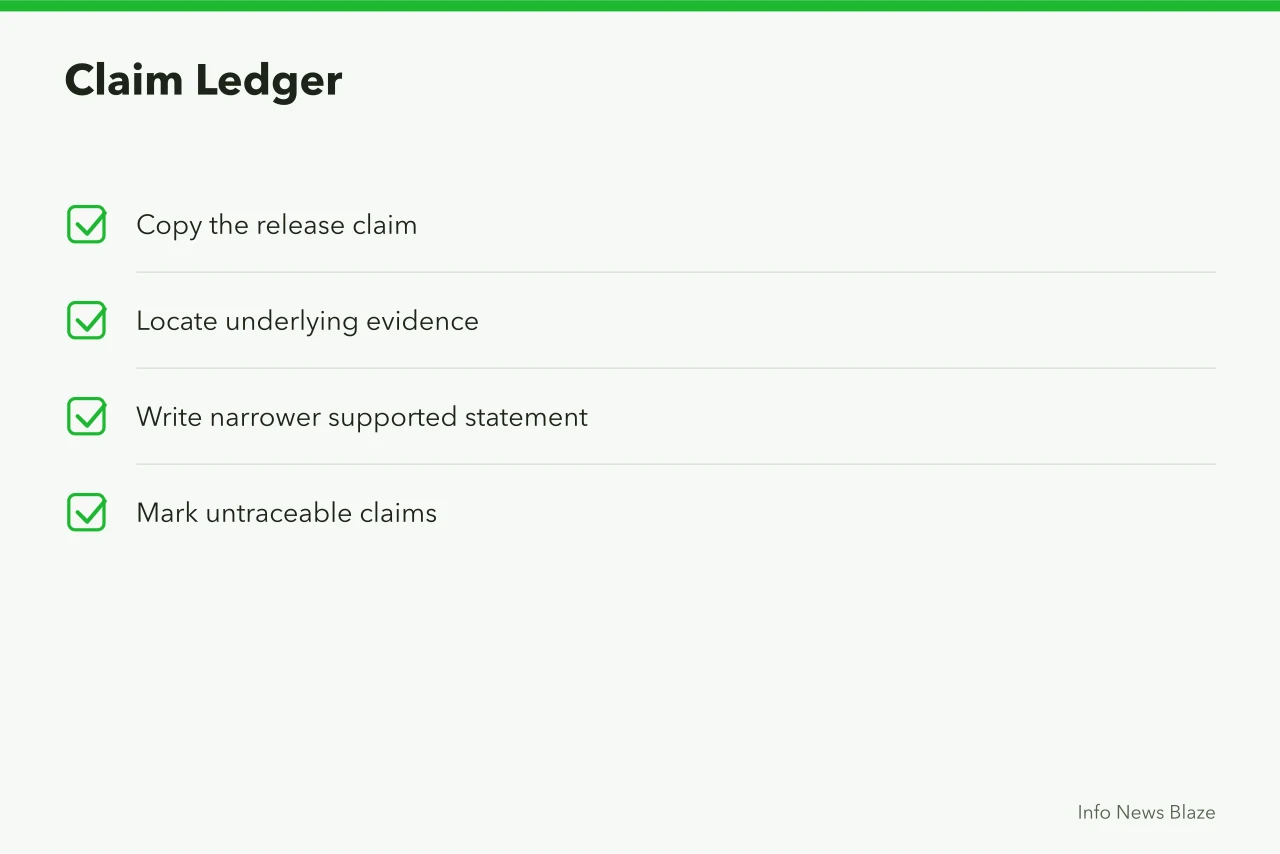
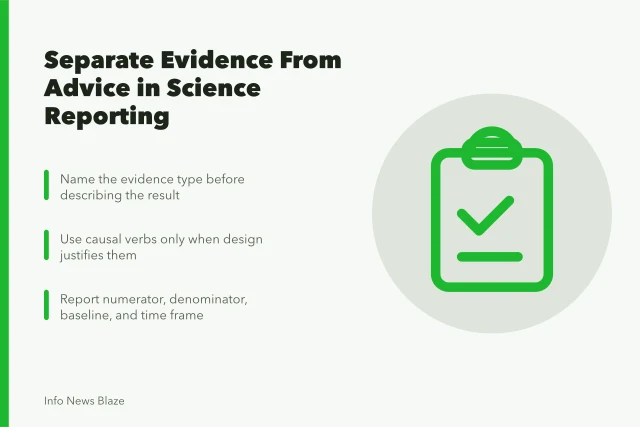
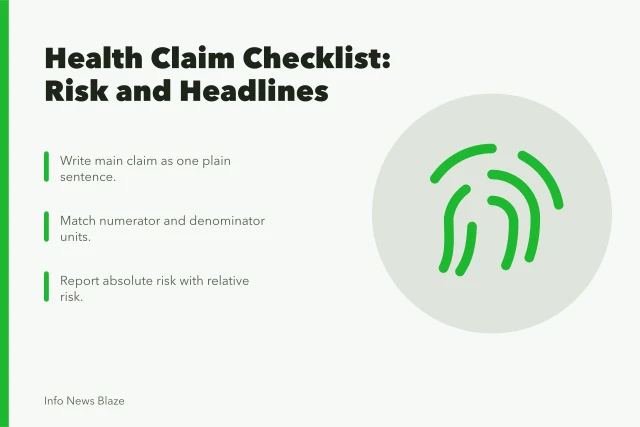
Fix: make a claim ledger with three columns. Copy the release claim, locate the underlying evidence, and write the narrower statement the evidence supports. Mark any claim that cannot be traced. The ledger's columns come from the health and science claim checklist.
A study of press releases and associated news coverage examined differences in reporting around randomized and observational health research. It supports inspecting how source materials describe design and causation. Its findings come from the releases and coverage in its sample, so they should not be turned into a claim that every release causes exaggeration.
Problem: the comparison disappears
"Risk fell by 30 percent" is incomplete without the two rates, population, and period. "Patients improved" is incomplete without what happened under usual care, placebo, another treatment, or the prior baseline.
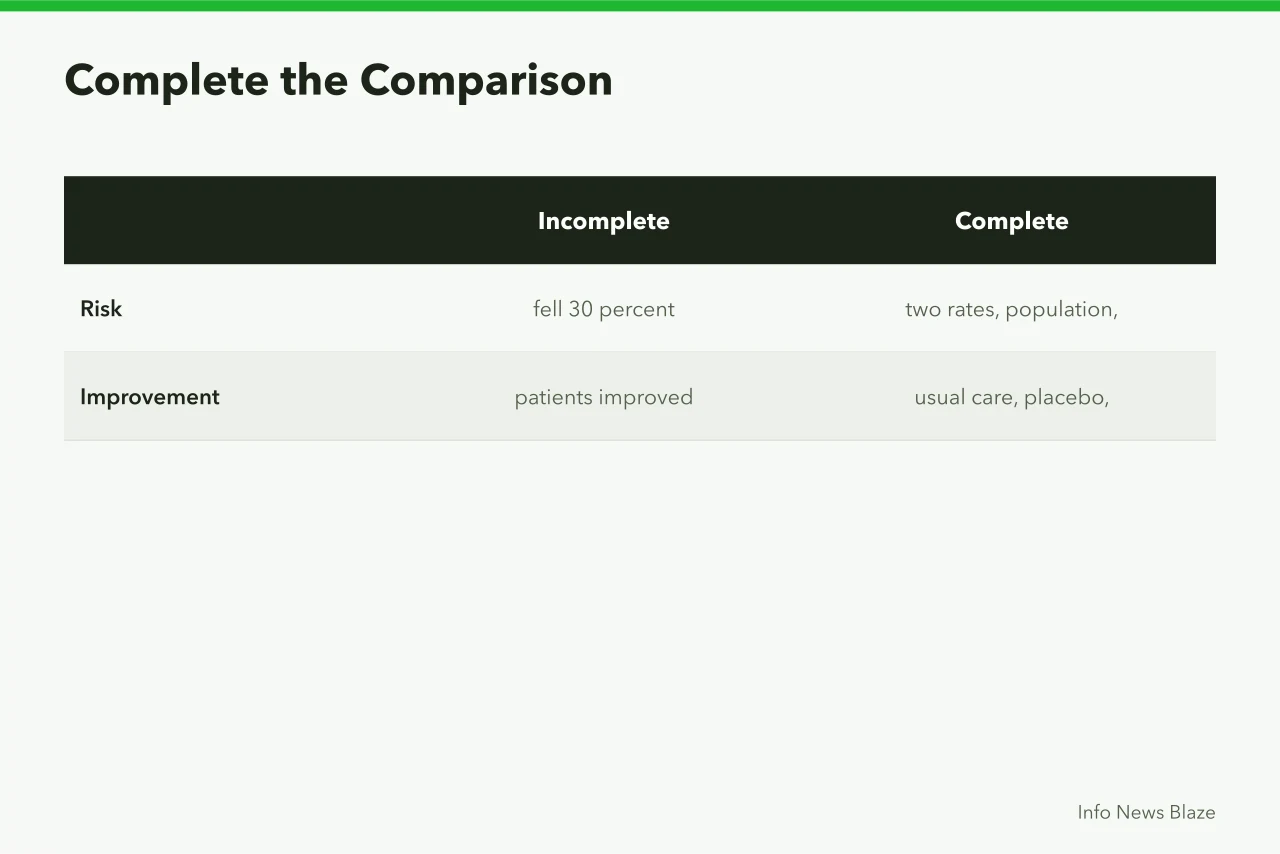
Fix: draft the result as a comparison before shortening it. If the source does not give the second quantity, ask for it or describe the missing comparison.
Problem: the causal verb grows during editing
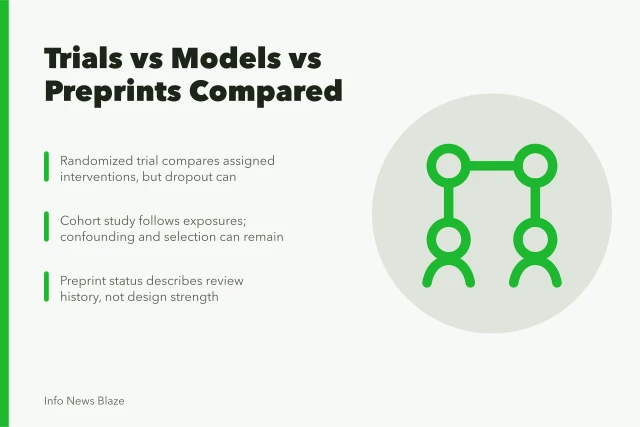
An observational paper says "associated with." A news release says "linked to." The headline says "drives." Each step sounds sharper, but the final version makes a claim the design may not support.
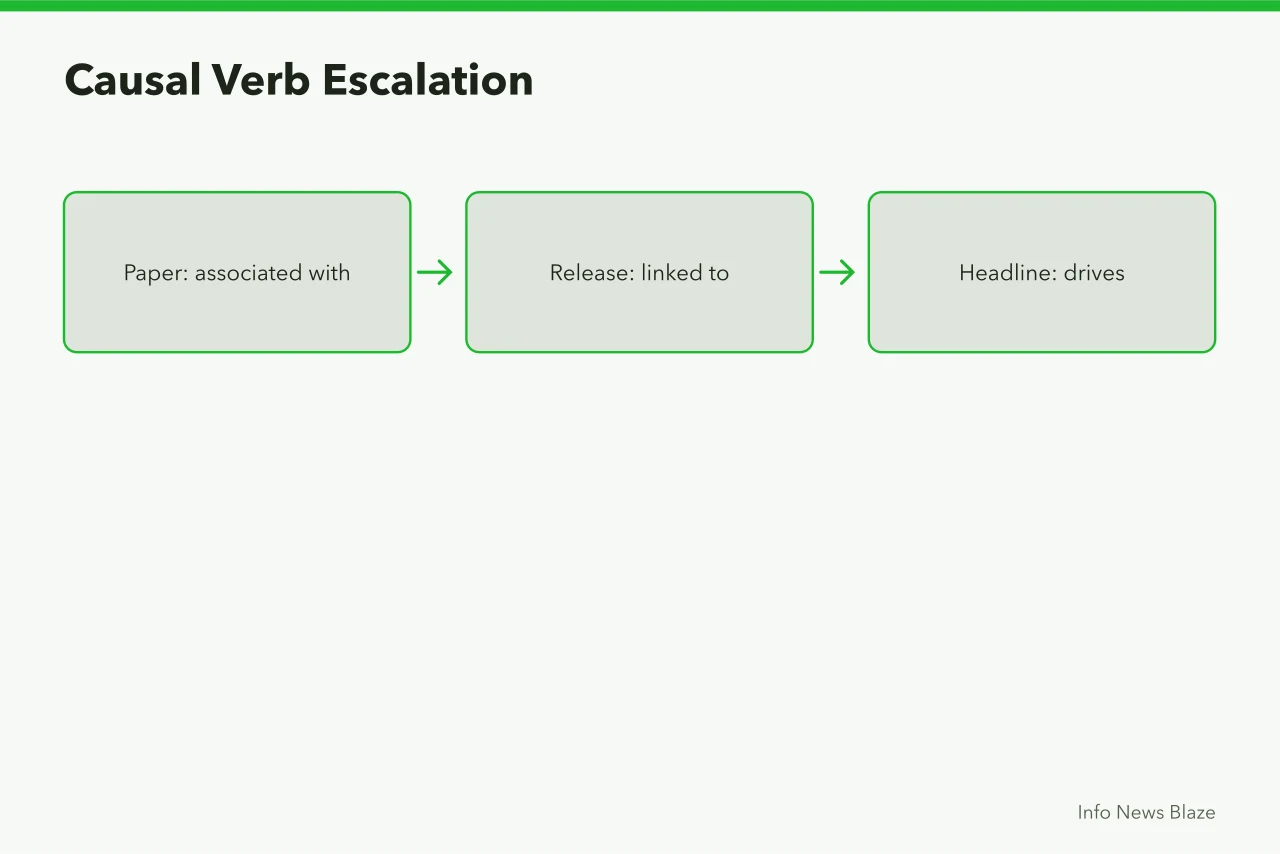
Fix: keep a design-to-verb note beside the headline field. Require a methods editor to approve "caused," "prevented," or "led to" when the source did not use causal language backed by the design. The verb-to-design pairing sits in the scientific evidence comparison.
Problem: the denominator changes
The story compares positive tests with all residents, adverse-event reports with doses, or survey respondents with registered users. That can create a rate whose parts do not describe the same population.
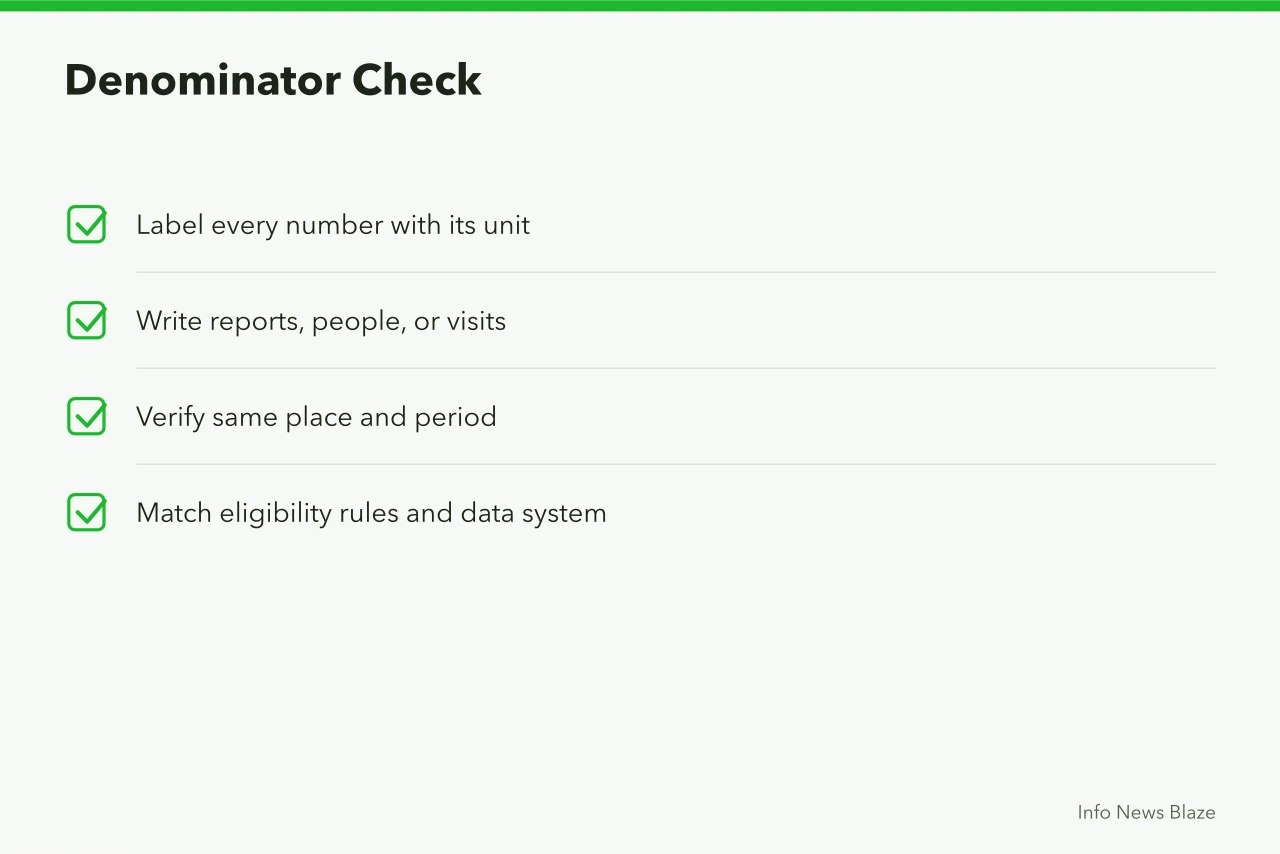
Fix: label every number with its unit in the notes. Write "47 reports," "47 people," or "47 visits," not just "47." Verify that numerator and denominator cover the same place, period, eligibility rules, and data system. Mismatched denominators also open the list of statistics reporting problems.
Problem: a surrogate replaces a patient outcome
A biomarker may help researchers study a disease or predict risk. A change in that marker is not automatically a change in symptoms, disability, hospitalization, or survival.
Fix: name the measured outcome first. Then explain why researchers use it and whether clinical benefit has been established separately.
Problem: outside comment is ornamental
A quote from a prominent scientist can look independent while adding little methodological scrutiny. The expert may work outside the relevant specialty, share an institutional relationship, or have a financial or advocacy interest.
Fix: ask the commentator to explain one design strength, one limit that changes interpretation, and the exact claim the data cannot support. Record relevant relationships and describe independence narrowly.
Research on expertise and conflicts among medical-news commenters assessed a particular sample of news stories and identified gaps in relevant expertise and independence among some commenters. The study supports checking both qualities. It does not justify assuming that any individual expert is conflicted or unqualified.
Problem: uncertainty is saved for the last paragraph
By the time a reader reaches a caveat, the headline and lead may have established a stronger conclusion. The correction has less force than the claim.
Fix: place the main boundary beside the result. Examples include "in mice," "in a preprint," "among 82 patients," or "under the model's central scenario." Keep the final limitations section for detail rather than first disclosure. Status-first labeling follows how to read a study or preprint, which puts review state beside the first result.
Problem: disagreement becomes a two-sided contest
Two quotes can create symmetry where the evidence is uneven. A credential alone does not show how much support a position has.
Fix: explain the basis of each claim. Compare study quality, relevant data, institutional review, and uncertainty. Do not count quotations as votes.
Problem: the update hides the original error
Quietly changing a number may fix the page while leaving syndicated copies, screenshots, and reader understanding untouched.
Fix: add a dated note when the correction changes meaning. State the old error, the correct information, and which parts of the story changed. Notify distribution partners when the error traveled beyond the page.
Common questions
Should a reporter ignore news releases?
No. They can point to papers, contacts, and institutional context. Treat them as leads and claims to verify.
Is one independent expert enough?
It depends on the claim and the available expertise. One suitable expert can expose a clear limit, while a disputed or cross-disciplinary question may require more review.
Can a small study be newsworthy?
Yes. Describe it as early or limited evidence, state the sample and design, and avoid a population-wide conclusion.
When does a correction need a note?
Use a note when the change affects meaning, magnitude, attribution, advice, or the reader's understanding of the evidence.