Maintenance
Part of Institutional claims guide: matching expertise to the actual claim
Expert source checklist: what to confirm before quoting anyone
Attribution and expert-source checklist for checking authority, evidence, document status, field, methods, interests, quotation context, anonymity, and updates.
What to take away
- Identify the source before testing the claim.
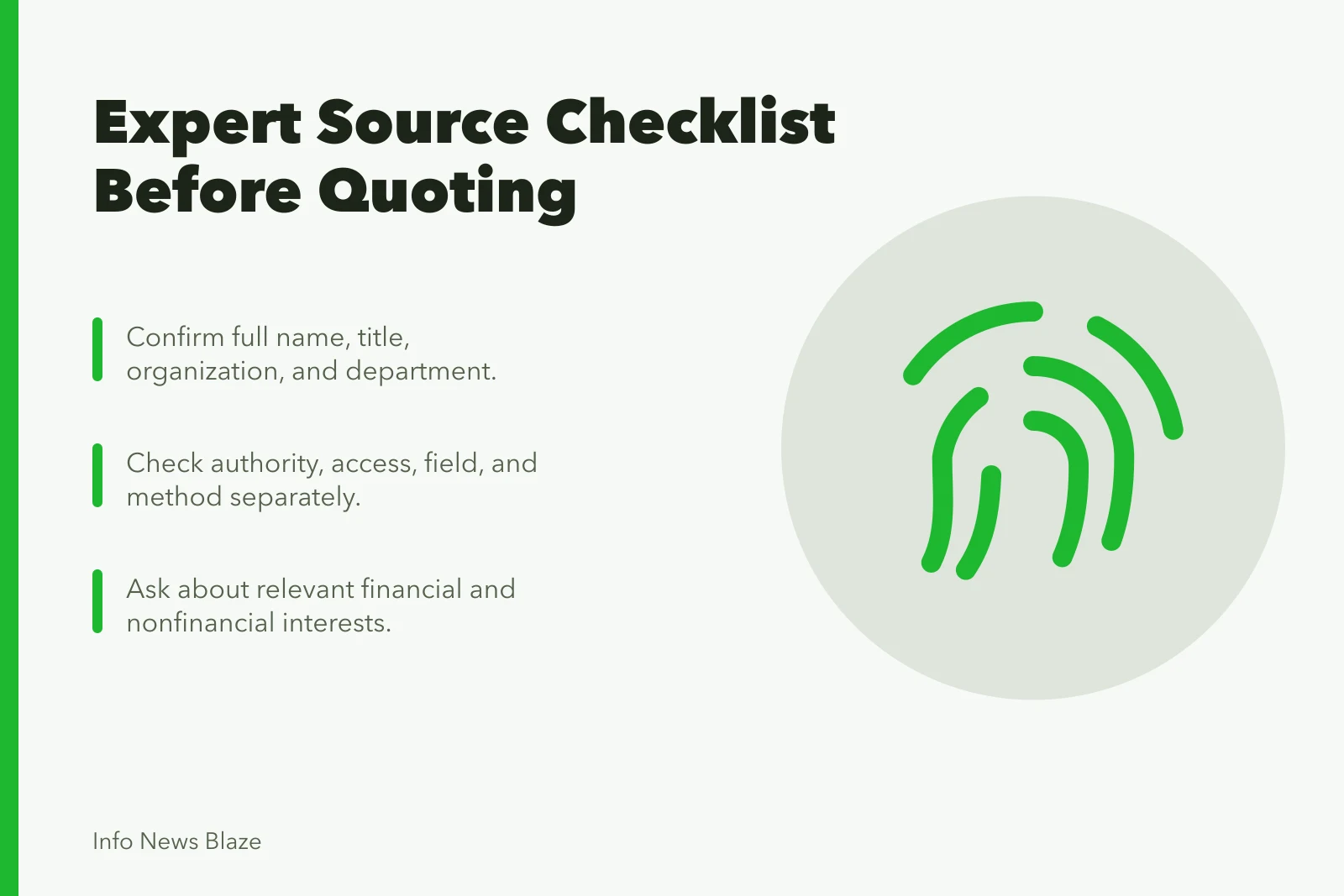
- Check authority, access, field, and method separately.
- Place source labels beside disputed or qualified statements.
- Ask about relevant financial and nonfinancial interests.
- Preserve recordings, documents, and version history.
Use this checklist before publication when an article depends on institutional statements, expert interpretation, anonymous sourcing, formal reports, or quoted material. Its structure follows the institutional claims and attribution guide.
Source identity
- Full name and spelling are confirmed.
- Current title, organization, and department are confirmed.
- The article distinguishes current, former, acting, interim, unpaid, and emeritus roles.
- The source's relationship to the event or evidence is clear.
- Contact came through a verified channel.
- The source knows whether remarks are on the record, on background, or under another agreed term.
Institutional authority
- The person is authorized to state the institution's position.
- Personal analysis is not presented as an institutional decision.
- The responsible office and jurisdiction are named.
- A spokesperson's answer is compared with the controlling document.
- Disagreement among offices is described rather than blended.
Evidence behind the claim
- The exact claim is written in one sentence.
- The source identifies the supporting record.
- The record's author, date, version, and status are known.
- Tables, appendices, notes, and methods were checked.
- The article separates data, interpretation, and recommendation.
What each supporting record can establish is the subject of the source material comparison.
Evidence behind the claim
- Exact claim written in one sentence
- Source identifies supporting record
- Record author, date, version, status known
- Tables, appendices, notes, methods checked
- Separate data, interpretation, recommendation
- Search for correction, amendment, withdrawal, retraction
Expert fit
- The exact question and needed field are defined.
- The expert's current work connects to that question.
- Relevant methods experience is checked.
- The source states the boundary of the comment.
- Another specialty is consulted when the claim crosses fields.
- Prestige and media frequency are not substitutes for fit.
The verification steps for fit and interests are detailed in checking an expert's credentials.
Expert fit checks
- Exact question and needed field defined
- Expert's current work connects to question
- Relevant methods experience checked
- Source states boundary of comment
- Consult another specialty when claim crosses fields
- Prestige and media frequency not substitutes for fit
Interests and disclosure
- Research funding and institutional support were asked about.
- Employment, consulting, fees, travel, and board roles were asked about.
- Patents, investments, licensing, and paid testimony were asked about.
- Advocacy, litigation, policy, or direct project roles were asked about.
- The time window fits the subject.
- The article describes the relationship without declaring the opinion false by association.
WHO's publication on declarations of interest for experts says people serving WHO in an advisory role must disclose circumstances that could create an actual or apparent conflict. This supports asking about more than a narrow admission of bias. It is WHO's process, so the article should not imply that an outside interviewee completed that formal review.
Before moving to an institution's formal finding, write the source's answers in concrete terms. Record who paid whom, for what work, during which period, and whether the relationship continues. Separate support to a department from income paid to the individual. Note whether a patent is owned, licensed, pending, or unrelated to the claim.
That short record stops a broad label from hiding a limited relationship. It also gives the source a chance to correct a factual description before publication, without controlling the newsroom's judgment. The health and science claim checklist applies the same questions to medical stories.
Research support and institutional review
NIH guidance on disclosure of support, affiliations, and conflicts describes applicant and recipient duties to report sources of support and relevant affiliations, and institutional duties to review significant financial interests for NIH-funded work. The scope is funding compliance, but it shows why "the author disclosed a relationship" and "the institution determined a managed conflict" are different statements.
- The article uses the institution's exact disclosure status.
- "No conflict" is not inferred from an empty biography.
- A management plan is distinguished from elimination of the interest.
- Institutional funding and individual payment are not conflated.
Quotations and anonymity
- Audio, notes, or transcript support the wording.
- Edits do not change meaning or remove a material condition.
- The quote is not presented as an answer to a different question.
- Translation has a named method and second check when material.
- An anonymous source has direct access and a stated reason for protection.
- The description gives useful context without exposing identity.
Final desk check
- Attribution appears at the first disputed claim.
- Headline wording does not adopt one party's allegation.
- Captions identify illustration versus evidence.
- Contact details and source files are preserved.
- A reporter owns the next document or disclosure check.
- Corrections will reach every distribution channel.
Common questions
Should every source receive a conflict disclosure line?
No. Include relationships that help readers assess the specific comment. The desk should still ask when the subject creates a reasonable possibility of a relevant interest.
Is institutional funding the same as personal payment?
No. Both can matter, but state which occurred and how the person or unit was connected to it.
Can a spokesperson be quoted as an expert?
Only if the person also has relevant expertise and the article distinguishes that analysis from the institution's position.
What makes anonymous attribution useful?
It should describe the source's access and role closely enough for readers to judge the claim while preserving the protection promised.