Features
Part of Business and economic reporting: a guide to numbers and claims: the 2027 view
Why do payroll numbers revise so much after the first report?
Payroll numbers revise so much after the first report because initial estimates rely on incomplete survey responses and late-arriving employer filings.
What to take away
- The first print is a sample result, not a settled count; the next two monthly releases replace it.
- Rebuild any three-month average from the current values, never from the numbers you published last month.
- Label each change by kindmonthly sample revision, annual benchmark, or seasonal-adjustment recalculation.
- A downward revision is not a correction unless the agency says an error was found.
- Keep the August table on file so later coverage can show what was known at the time.
This fictional desk case uses invented dates, figures, employers, analysts, and quotations. The cited Bureau of Labor Statistics pages support the method and terminology, not the fictional results.
The first print
At 8:30 a.m. the fictional report puts August nonfarm payroll employment up 92,000. The unemployment rate moves from 4.0 to 4.2 percent. June and July payroll estimates are revised down by a combined 118,000.
The first headline draft reads:
Economy adds 92,000 jobs as unemployment suddenly jumps
That line merges two surveys without saying so, buries the revisions, and treats a rounded rate move as self-explanatory. Letting a first print stand as permanent history is the failure cataloged in economic reporting problems.
Two surveys, two counts
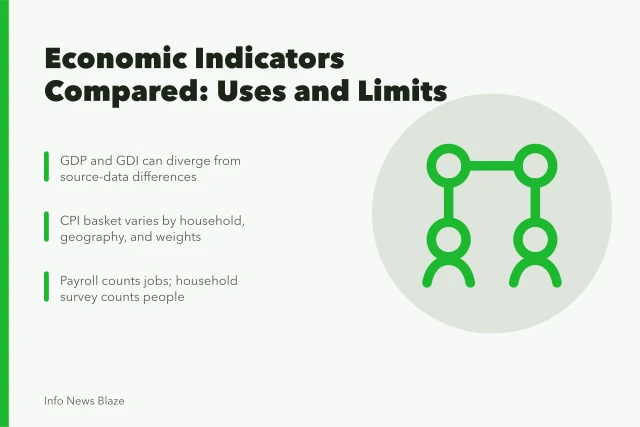
Payrolls come from an establishment survey that counts jobs. The unemployment rate comes from a household survey that sorts people by labor-force status. One person holding two covered payroll jobs appears twice in the establishment count and once in the household survey.
The BLS quick guide to Employment Situation methods sets out those separate concepts and covers monthly revisions, sampling error, and annual benchmarking. Report the two series side by side as different views of the same labor market. Do not force them into one arithmetic balance.
Rebuild the recent sequence
The desk builds a revision table before writing anything.
Payroll revisions and averages
- June revision-65,000
- July revision-53,000
- August revisionnot yet revised
- Three-month average now80,333
- Three-month average a month ago119,667
| Month | First payroll estimate | Current estimate | Revision |
|---|---|---|---|
| June | 146,000 | 81,000 | -65,000 |
| July | 121,000 | 68,000 | -53,000 |
| August | 92,000 | 92,000 | Not yet revised |
August is not the whole story. On current values the three-month average is 80,333, against 119,667 as readers saw it a month earlier. Compute any average from current vintages and mark August preliminary. That discipline is the core of reading an economic release.
Name the kind of revision
Monthly payroll estimates move as more sampled employers respond. Annual benchmarks re-anchor the series to more complete administrative counts. Seasonal adjustment can also restate historical seasonally adjusted values.
Three kinds of payroll revision
Monthly sample revision
- What changes
- Late employer reports
- Source
- Sample responses
- Timing
- Next two months
- Meaning
- More data
Annual benchmark
- What changes
- Administrative counts
- Source
- UI records
- Timing
- Annual
- Meaning
- Re-anchoring
Seasonal adjustment
- What changes
- Seasonal factors
- Source
- Statistical model
- Timing
- Can revise for years
- Meaning
- Recalculation
The BLS Current Employment Statistics revision FAQ says initial monthly estimates are revised over the next two months as late sample reports arrive. It describes annual benchmarking, drawn mainly from unemployment-insurance records, and notes that seasonally adjusted estimates can keep revising for years.
Say which process produced the change. A monthly sample revision, a benchmark, and a seasonal recalculation are three different events with three different meanings.
Read the rate move
Unemployment can rise while payrolls rise if the labor force grows faster than employment, and it can rise on sampling variation alone. Check the household-survey levels, labor-force participation, the employment-population ratio, and the published precision information before writing the move up.
Do not call a one-decimal-point change a surge. Give the current rate, the prior rate, the underlying context, and a restrained description. The seasonal data desk case applies the same restraint to surge language.
Draft the second headline
Payroll growth slows to 92,000 in August as earlier gains are revised lower
That version holds the preliminary payroll figure and the revision pattern in one line. A subheading can carry the separately measured unemployment rate and its change.
If the desk leads with the rate instead, explain the household survey in the opening paragraphs and keep the payroll estimate out of the denominator.
Check industry, hours and pay
Split the 92,000 by industry to see whether one sector carried it. Check whether a strike or severe weather disrupted collection in the reference period. Look at average weekly hours, which often move before headcount does.
Average hourly earnings need their own period and population, and a change in the average can come from a shift in worker mix rather than from raises. Never write that every worker received the published average increase. The average-versus-typical distinction is drawn in the economic indicators comparison.
Schedule the follow-up
Log the next two monthly release dates, the preliminary benchmark date, and the final benchmark publication. Save the August table so later coverage can separate what was known in August from what the historical series eventually shows.
If revisions turn the slowdown into a flat trend or a contraction, add a dated update note to the live explainer. The original alert should not be the only version a reader can still find.
Common questions
Why can payrolls rise while unemployment also rises?
The two figures come from different surveys, and the rate also depends on labor-force participation. Both can rise at once without any mathematical contradiction.
Is the newest payroll figure final?
No. Initial estimates normally take monthly revisions and later benchmark treatment under the program's published process.
Does a downward revision mean the agency made a mistake?
Not necessarily. Later employer responses and more complete records can move a sample-based estimate. A correction for an identified error is a separate event and should be labeled as one.
Which number belongs in the headline?
Pick the measure that answers the story's central question. Do not combine jobs and people as though they came from a single count.