Guides
How Cap-and-Trade Programs Move Gas Prices: A State-by-State Guide
How allowance and credit costs reach the pump: the conversion math, pass-through rules, and which state carbon markets put a price on fuel today.
What to take away
- A cap-and-trade program sets a price per metric ton of carbon, and fuel suppliers convert that price into cents per gallon.
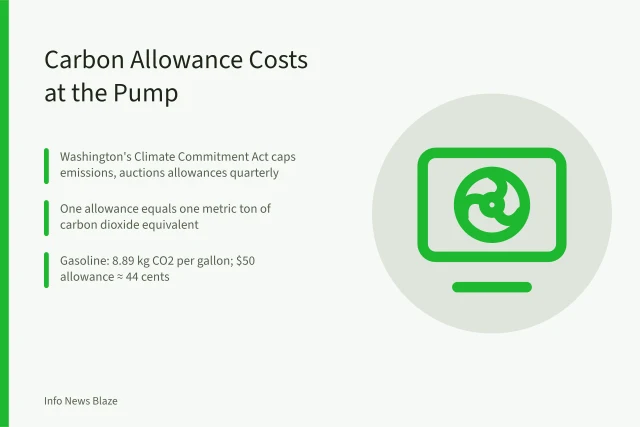
- Gasoline emits about 8.89 kilograms of CO2 per gallon, so a $30 allowance equals roughly 27 cents per gallon at full pass-through.
- California, Washington, and Oregon put a carbon price on transportation fuel, and New Mexico is building a clean fuel standard.
- Whether the cost reaches the pump depends on competition, the point of obligation, and how much margin suppliers give up.
Where a carbon price attaches to the fuel chain
A cap sets a total tonnage of emissions for covered sources. Fuel suppliers must surrender one allowance for every metric ton of CO2 that the fuel they sell will produce. They buy those allowances at auction or on the secondary market.
Each program names a regulated party, often called the point of obligation. California places it on refiners and importers of transportation fuel. Washington and Oregon put it on fuel suppliers. That choice decides where the cost first enters the price chain.
If the refiner is the regulated party, the allowance cost usually enters the wholesale rack price. Distributors and retailers then build margins on a higher base. If a distributor is regulated, the cost shows up one step later.
Converting a ton price into cents per gallon
The math is short. Multiply the allowance price by the fuel carbon content per gallon, then apply the pass-through share. The practical detail is set out in Washington state climate laws and the.
| Allowance price per metric ton | Gasoline, 8.89 kg CO2 per gallon | Diesel, 10.18 kg CO2 per gallon |
|---|---|---|
| $10 | about 9 cents | about 10 cents |
| $30 | about 27 cents | about 31 cents |
| $50 | about 44 cents | about 51 cents |
These figures assume full pass-through. Real fuel price increases are smaller when suppliers absorb part of the cost. They can be larger in tight markets where retailers hold pricing power.
Example: a $30 allowance in one state
Step 1. A state auctions allowances and the clearing price lands at $30 per metric ton. Step 2. A supplier sells 1 million gallons of gasoline, which carries 8,890 metric tons of CO2. Step 3. The allowance bill is $266,700, or about 27 cents per gallon. Step 4. The supplier adds that to its wholesale offer, and stations price from the higher rack.
If the supplier recovers only half, the pump effect is about 13 cents. Nothing on a pump receipt shows which portion came from allowances.
Which states put a carbon cost on fuel
| Jurisdiction | Program | Covers transportation fuel | Where the cost lands |
|---|---|---|---|
| California | Cap-and-trade, 2013, plus Low Carbon Fuel Standard | Yes, fuels added in 2015 | Wholesale rack, then pump |
| Washington | Climate Commitment Act cap-and-invest, 2023, plus Clean Fuel Standard | Yes | Wholesale rack, then pump |
| Oregon | Climate Protection Program and Clean Fuels Program | Yes | Wholesale rack, then pump |
| New Mexico | Clean Transportation Fuel Standard, adopted 2024 | Yes, rules pending | Credit cost in fuel |
| RGGI states | Regional Greenhouse Gas Initiative | No, power plants only | Electric bills |
| Most states | No carbon price on fuel | No | None |
Oregon's Climate Protection Program was invalidated by a state court in 2023 and later re-adopted through new rulemaking. Washington's program survived a repeal vote in November 2024.
The mechanics differ in Washington, where allowance auctions set the carbon price and no official cents-per-gallon rate is published.
Clean fuel standards use credits, not allowances
A clean fuel standard sets a declining carbon intensity target for fuels sold in a state. Producers of low-carbon fuels earn credits. Suppliers of high-carbon fuels generate deficits and must buy credits to cover them.
The credit price, not an allowance price, drives that cost. It lands hardest on fuels with the highest carbon intensity. The same program also subsidizes alternatives, so it can push some prices up and others down at once.
California, Oregon, Washington, and New Mexico each run or are building a clean fuel standard. Each has its own credit market and compliance schedule.
Why the pump price moves less than the carbon price suggests
Pass-through is a business decision as much as a policy one. A supplier facing competitors that also hold allowances tries to recover the cost. A supplier in a price war may wait.
Timing matters too. Allowances are often purchased quarterly, while fuel is priced daily. That gap hides the carbon cost inside ordinary wholesale swings.
Fuel taxes are separate. Federal and state excise taxes are fixed per gallon. A carbon allowance cost is not a tax and is not itemized at the station.
How to check a program's real cost
Refiners and fuel distributors describe carbon compliance costs in their annual reports. You can pull a filing through the SEC EDGAR company search and read the sections on margins and environmental obligations.
The SEC investor bulletin on reading a 10-K explains where risk factors and management discussion sit in the document.
State air agencies publish auction settlement prices. Those prices, not a published per-gallon rate, are the input you multiply by the fuel carbon factor.
For federal proposals, the Senate briefing on how a bill becomes law describes the committee and floor steps a national program would still face. The 2009 Waxman-Markey bill passed the House and never reached a Senate vote.