Guides
How State Carbon Markets Set the Fuel Price You Pay at the Pump
Washington's cap-and-invest allowance auctions set a carbon price that fuel suppliers turn into cents per gallon at the pump, and no official rate is published.
What to take away
- Washington's Climate Commitment Act caps carbon emissions and makes fuel suppliers buy allowances at quarterly state auctions.
- Each allowance covers one metric ton of carbon dioxide equivalent, and the auction price becomes a per gallon cost through a simple conversion.
- Suppliers decide how much of that cost reaches the pump, so no single official number describes the surcharge.
- A separate Clean Fuel Standard credit market can stack another cost on top of the allowance cost.
The Chain From Auction to Wholesale Fuel Price
Washington's Climate Commitment Act became law in 2021 as Senate Bill 5126. It followed the committee, floor, and signature path that explains how a bill becomes law.
Covered entities include fuel suppliers that bring at least 10,000 metric tons of carbon dioxide equivalent into the state in a year. Each allowance represents one metric ton. Suppliers must surrender allowances equal to their reported covered emissions.
The Department of Ecology runs the program, and auctions sell allowances on a quarterly schedule.
- Ecology sets the annual emissions cap and the matching number of allowances.
- The agency holds auctions on a quarterly calendar with a reserve floor price and a ceiling price.
- Bidders submit sealed bids, and one clearing price applies to all winning bids.
- Allowances can be resold, so a secondary market price forms between auctions.
- At compliance time, each supplier surrenders allowances equal to its reported emissions.
Those five stages turn a policy cap into a tradable cost that refiners and importers must carry.
Washington Cap and Invest Auction Mechanics
| Stage | What happens | Who controls it |
|---|---|---|
| Cap setting | Ecology sets the annual allowance budget | Department of Ecology |
| Auction | Quarterly sealed bid sale | Ecology and the auction administrator |
| Settlement | One clearing price applies to winning bids | Auction results |
| Secondary market | Participants resell allowances | Market participants |
| Compliance | Allowances are surrendered for reported emissions | Covered fuel suppliers and other emitters |
Because settlement prices are published, the allowance cost is visible to anyone, even when the pump cost is not.
Example: Converting an Allowance Price Into Cents per Gallon
One allowance equals one metric ton of carbon dioxide equivalent.
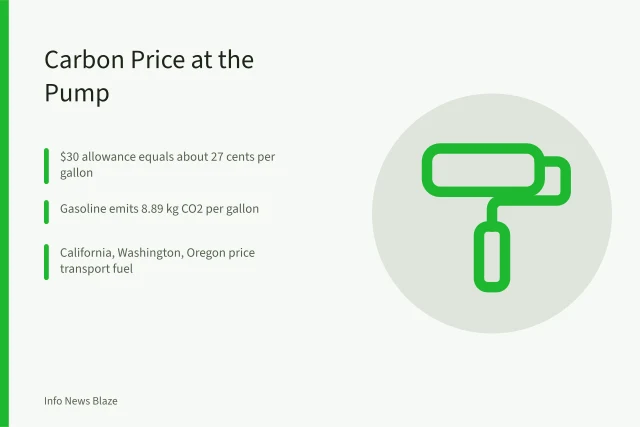
Burning one gallon of gasoline releases about 8.89 kilograms of carbon dioxide. Divide by 1,000 to get 0.00889 metric tons per gallon. Then multiply by the allowance price.
At $50 per allowance, the result is roughly 44 cents per gallon if a supplier passes through the full cost. Diesel carries a higher carbon factor, about 10.18 kilograms per gallon.
That arithmetic is an illustration, not an official rate. Real pass through varies by company, contract, and timing.
The Second Cost Layer: Washington's Clean Fuel Standard
Washington also enforces a Clean Fuel Standard, which pushes transportation fuel toward lower carbon intensity. Suppliers that fall short of the annual target buy credits from cleaner fuel producers. Credit prices move on their own schedule, separate from allowance auctions. Two carbon costs can therefore sit inside the same wholesale price.
For the statutes behind both programs, this Washington climate law primer explains what each one requires.
Where Pass Through Shows Up and Where Claims Get Checked
Some retailers print a carbon or climate surcharge as a separate line on a receipt. When a business attributes a price increase to a state program, that statement counts as advertising. The FTC checks whether business claims are truthful and supported by evidence, and its substantiation rules for advertising claims describe what that requires.
Publicly traded refiners describe carbon compliance costs in their annual reports. SEC interpretations of Regulation S-K explain what belongs in risk factors and MD&A when those costs are material.
The EDGAR company search lets you pull a specific company's 10-K and read its risk factors section directly.
Reading those filings shows how much of the cost a company treats as material, and how carefully it words the estimate.
What Remains Genuinely Uncertain
Three pieces stay open. The allowance price changes at every auction and in secondary trading. Lawmakers have discussed linking Washington's market with California and Quebec, which would shift prices and rules. And the share that any one retailer passes through is a private pricing decision.
- The next auction settlement price.
- Whether linkage talks produce an agreement.
- How much of the cost each supplier absorbs.