Maintenance
Part of Science reporting guides work best when evidence and advice stay separate
Health claim checklist: relative risk and the headline warning
Health and science claim checklist for checking evidence, risk numbers, study populations, conflicts, uncertainty, practical advice, headlines, and updates.
What to take away
- Turn each public claim into a statement that can be checked.
- Match numbers to their population, denominator, and period.
- Ask for absolute risk as well as relative risk.
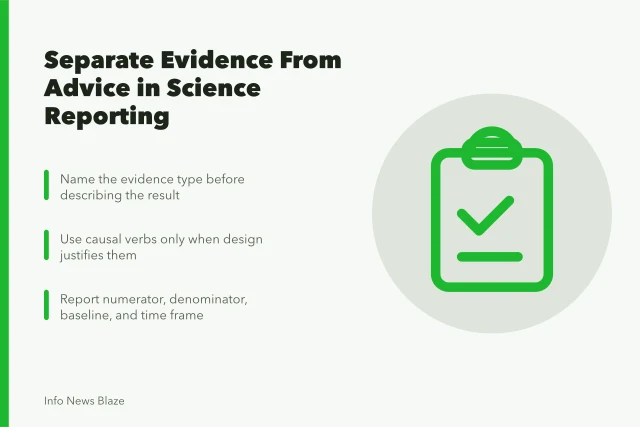
- Keep research findings separate from medical advice.
- Plan corrections and updates before publication.
Use this checklist after reporting and before headline approval. It is built for studies, agency announcements, medical news releases, expert claims, and public-health briefings. A blank answer is a reporting task, not a box to wave through. Its sections compress the science and health reporting guide into yes-or-no form.
Claim and source
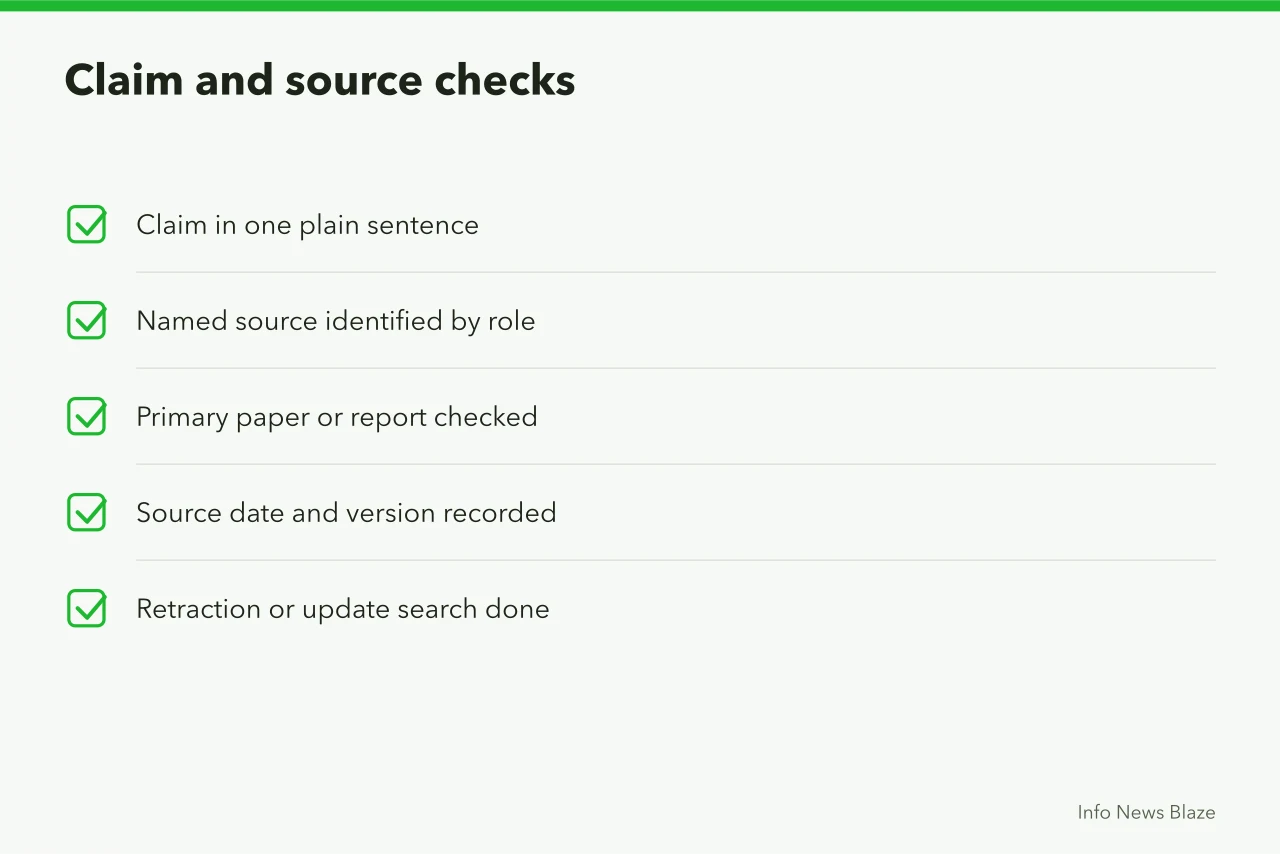
- The main claim is written as one plain sentence.
- The named source made that claim in a document, recording, or direct interview.
- The story identifies whether the source is an author, funder, regulator, clinician, agency, company, patient group, or independent researcher.
- A primary paper, dataset, protocol, order, or agency report was checked when available.
- The source date and document version are recorded.
- A correction, retraction, update, or later version search was completed.
Do not let a news release become the study. Use it to locate evidence and contacts, then compare its wording with the underlying record. The comparison method comes from how to read a study or preprint.
Study identity
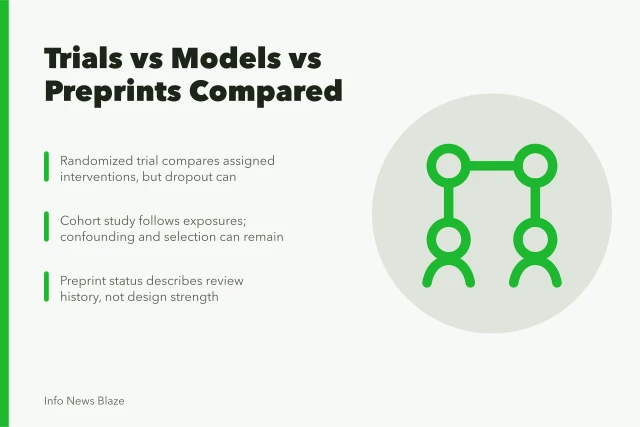
- Design is named accurately.
- Population, place, and recruitment method are clear.
- Sample size matches the analysis being reported.
- Exposure or intervention is defined.
- Comparison group or baseline is described.
- Primary outcome and time horizon are stated.
- Preprint, conference, peer-review, or regulatory status is prominent.
Numbers and risk
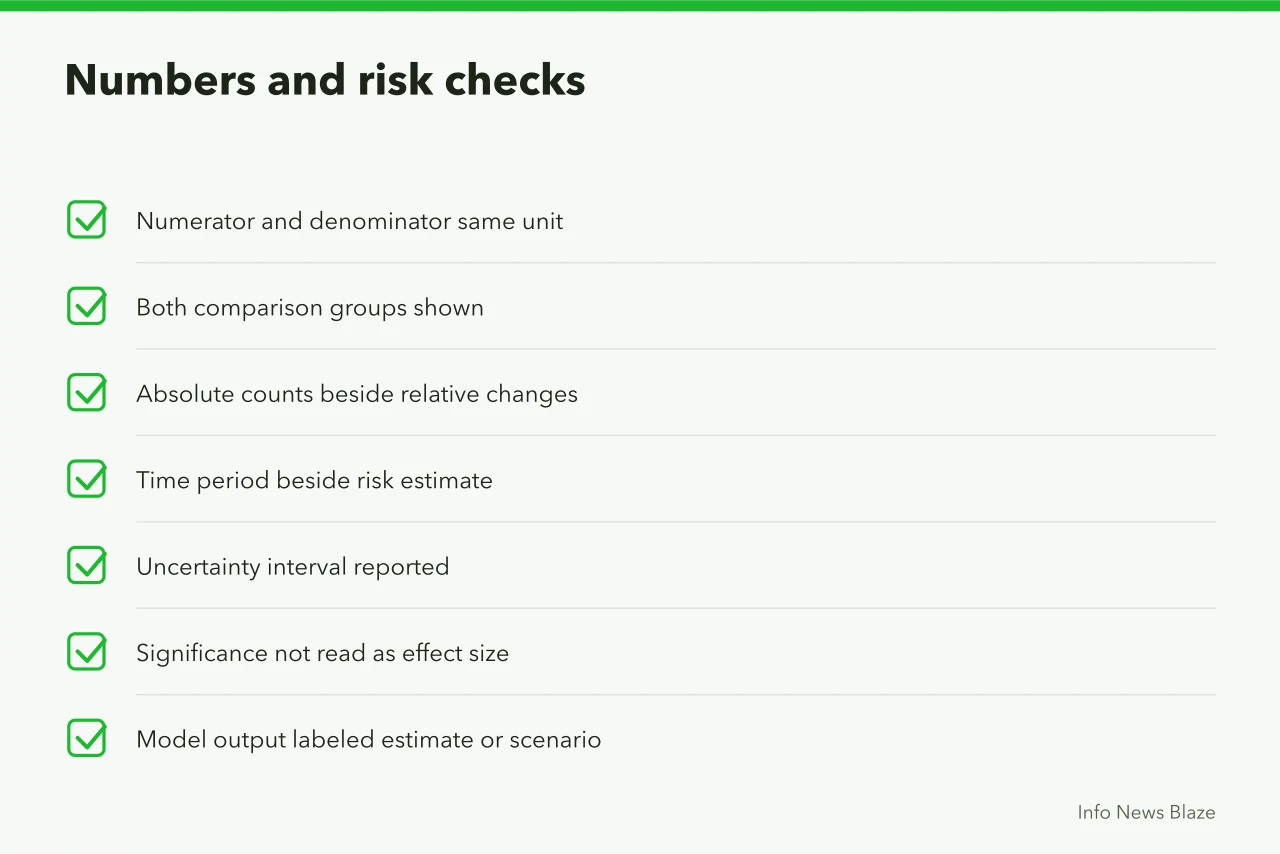
- Numerator and denominator have the same unit and population.
- Both comparison groups appear when relevant.
- Absolute counts or rates accompany relative changes when available.
- The time period sits beside the risk estimate.
- The uncertainty interval or range is reported when it affects interpretation.
- Statistical significance is not presented as the size or importance of an effect.
- A model output is labeled as an estimate or scenario.
The FDA's evidence-based guide to communicating risks and benefits reviews how people interpret probability, uncertainty, and benefit-harm information. It supports presenting risk in forms that help readers compare outcomes, while the exact format still has to fit the evidence and audience.
Causation and scope
- The verb fits the design.
- Association is not rewritten as cause.
- Laboratory or animal findings are not presented as demonstrated human effects.
- The story does not expand beyond the studied age, location, condition, dose, or period.
- Surrogate outcomes are identified as such.
- Subgroup findings are labeled and checked for prior specification and sample size.
Methods and missing information
- Inclusion and exclusion rules were reviewed.
- Loss to follow-up and missing measurements are described.
- Changes from the protocol or registered plan were checked.
- Outcome definitions did not shift unnoticed.
- Alternative explanations were discussed with a suitable expert.
- Data and code access, or their absence, is stated when it affects scrutiny.
Conflicts and independence
- Funding is named.
- Author disclosures were read.
- Relevant patents, employment, consulting, advocacy, or litigation roles were checked.
- Outside comment comes from someone with suitable methods or subject expertise.
- Independence is described precisely rather than assumed from a job title.
A conflict does not make a result false. It is context that helps readers judge incentives and the need for independent scrutiny. Evidence-type labels help too; the scientific evidence comparison states what each design can claim.
Public advice
- Advice is attributed to a named health authority or clinical body.
- The intended population is clear.
- Contraindications, urgent warning signs, or limits are included when the authority states them.
- The article does not prescribe individual treatment.
- Emergency and routine-care instructions are not mixed together.
- The advice has a date and review trigger.
Headline and visual check
- The headline does not claim more than the body.
- The population or evidence type appears when its omission would mislead.
- The image does not imply a person has the condition being reported.
- A chart begins at a defensible baseline and labels units.
- Color and scale do not magnify a small difference.
- The caption separates illustration from evidence.
Relative-risk warning
The CDC journal article on risk reporting in health news explains that relative risk without event rates can make an effect appear larger to readers. It discusses research findings rather than issuing a universal writing formula, but it supports checking whether a story supplies the underlying rates needed to judge magnitude.
For example, a change from 1 event per 10,000 to 2 per 10,000 is a doubling and an increase of 1 event per 10,000. Both descriptions are mathematically correct. Together they give readers a usable scale. Percentage-point arithmetic of this kind is drilled in the statistical claim checklist.
Update plan
- A reporter owns the next check.
- The check date follows the next expected paper, agency report, hearing, or review.
- Contact details and document identifiers are saved.
- The correction standard distinguishes a typo from a change in meaning.
- Archived copies preserve what was reviewed.
Common questions
Must every story include every checklist item?
No. Use the items that can alter the claim, reader action, or interpretation. The desk should record why a material check does not apply.
Is a disclosure proof of bias?
No. A disclosure identifies a relationship. Assess the methods and seek suitable independent review without declaring the result false by association.
Can a headline use a relative percentage?
Yes, when the base rates and period appear prominently and the relative figure does not distort the practical size.
What should trigger an update?
A corrected paper, new version, regulator decision, changed guidance, larger study, new safety signal, or revised dataset may justify one.