Features
Case study: a fictional planetary data announcement
Fictional planetary data case showing how a news desk handles mission status, preliminary measurements, calibration, archive release, outside review, and correction.
What to take away
- This case is fictional and describes no real mission or discovery.
- A mission-team briefing is separated from an archived dataset and journal paper.
- Preliminary measurements retain calibration and uncertainty limits.
- Engineering success is not rewritten as proof of a scientific interpretation.
- The story changes when reviewed data and analysis become available.
At 11 a.m., the fictional Horizon Crater mission team announces that an instrument detected an unusual mineral signature during three passes over a fictional asteroid. The team releases a briefing deck and two calibrated example spectra. It says a full archive bundle and manuscript will follow. Every name, measurement, schedule, and result below is invented.
Info News Blaze publishes explanatory news and background briefings on stories in the news. This fictional case is a reading exercise for real planetary data announcements.
Those stories often arrive in stages, from a briefing to an archive to a paper. The case shows how to separate those stages and avoid treating a candidate as confirmed. The habits apply when a real space mission is in the news.
First report: state what exists
A reader identifies the available records: an agency briefing, instrument description, sample spectra, and team quotes. No journal paper or complete archive is available. The headline says the team reports a candidate mineral signature. It does not say the mineral has been discovered or independently confirmed. The status-first habit follows the science announcement reporting guide.
NASA's Planetary Data System tells providers to work with a relevant discipline node, create standardized product descriptions, and clear peer review and lien resolution before online availability. The PDS information for data providers supports distinguishing selected briefing data from a documented archive product that has completed its review process.
Build the claim ledger
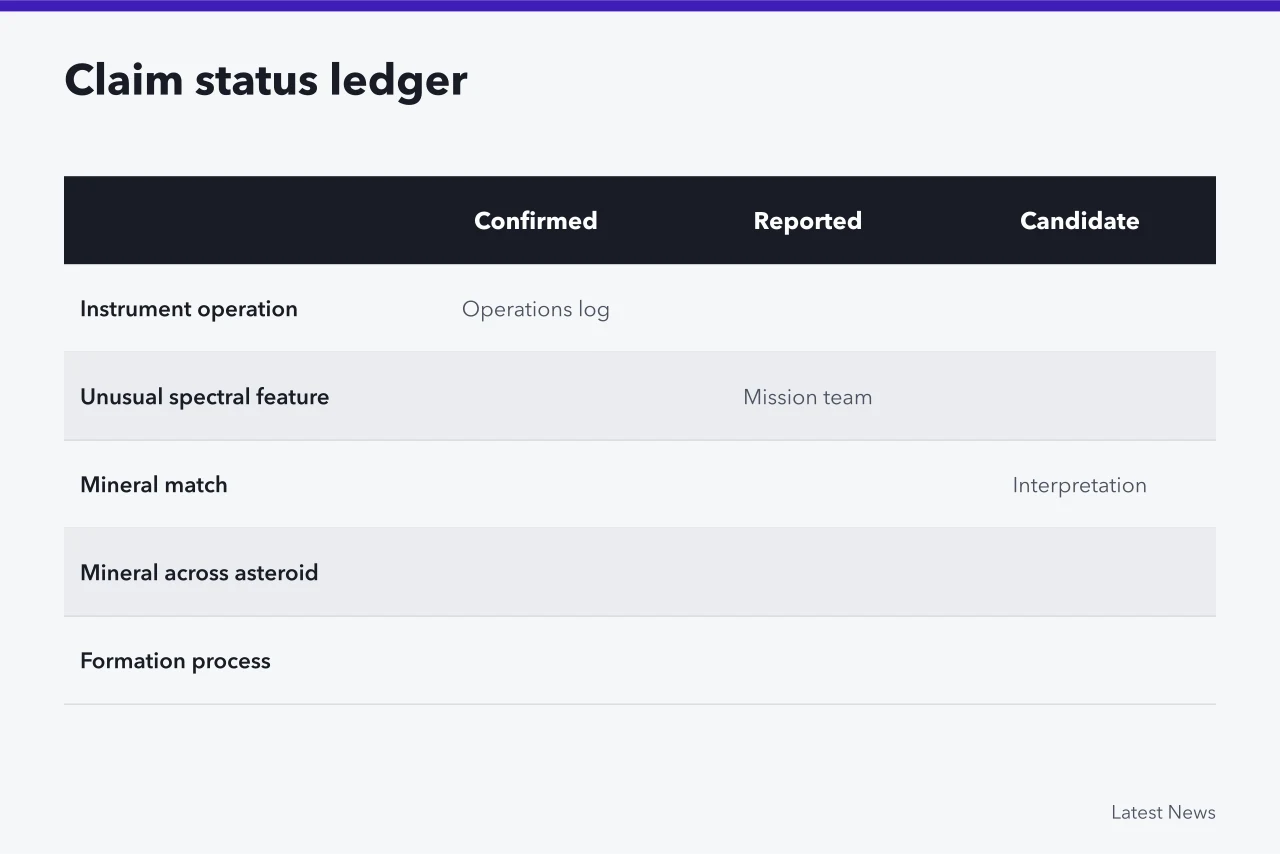
| Claim | Fictional status |
|---|---|
| Instrument operated during three passes | Confirmed by mission operations log |
| Spectra contain an unusual feature | Reported by mission team |
| Feature matches a mineral | Candidate interpretation |
| Mineral exists across the asteroid | Not established |
| Formation process is known | Not established |
The article asks about calibration targets, noise, processing version, detector temperature, spatial coverage, alternative materials, and the threshold used to call a match.
It also asks for observation identifiers and the planned archive date. It asks if the two released spectra were selected for looking strongest, and if other passes returned null results.
Without the complete set, the article avoids estimating how common the feature is across the target. Reading the deck against its underlying records follows how to read a science press release.
Keep mission stage separate
The spacecraft completed commissioning two months earlier, but the mission remains in its planned science-operations phase. The new analysis does not change engineering status. NASA's program and project life-cycle overview distinguishes development, system assembly and test, launch, checkout, and operations.
The fictional story uses the mission's documents for exact gates while keeping those general stages separate. Cases in other domains keep stages apart the same way; the interest rate decision case separates a vote, projections, and commentary.
Outside review
Two researchers without mission roles receive the deck and spectra. One says the candidate match is plausible but asks for full wavelength coverage. The other identifies a calibration artifact that should be tested. Their comments are described as assessments of limited public material, not replication.
Archive release
Six weeks later, the fictional archive posts a documented bundle with raw, calibrated, and derived products. Processing differs from the briefing version, and one of three signals weakens after a calibration correction.
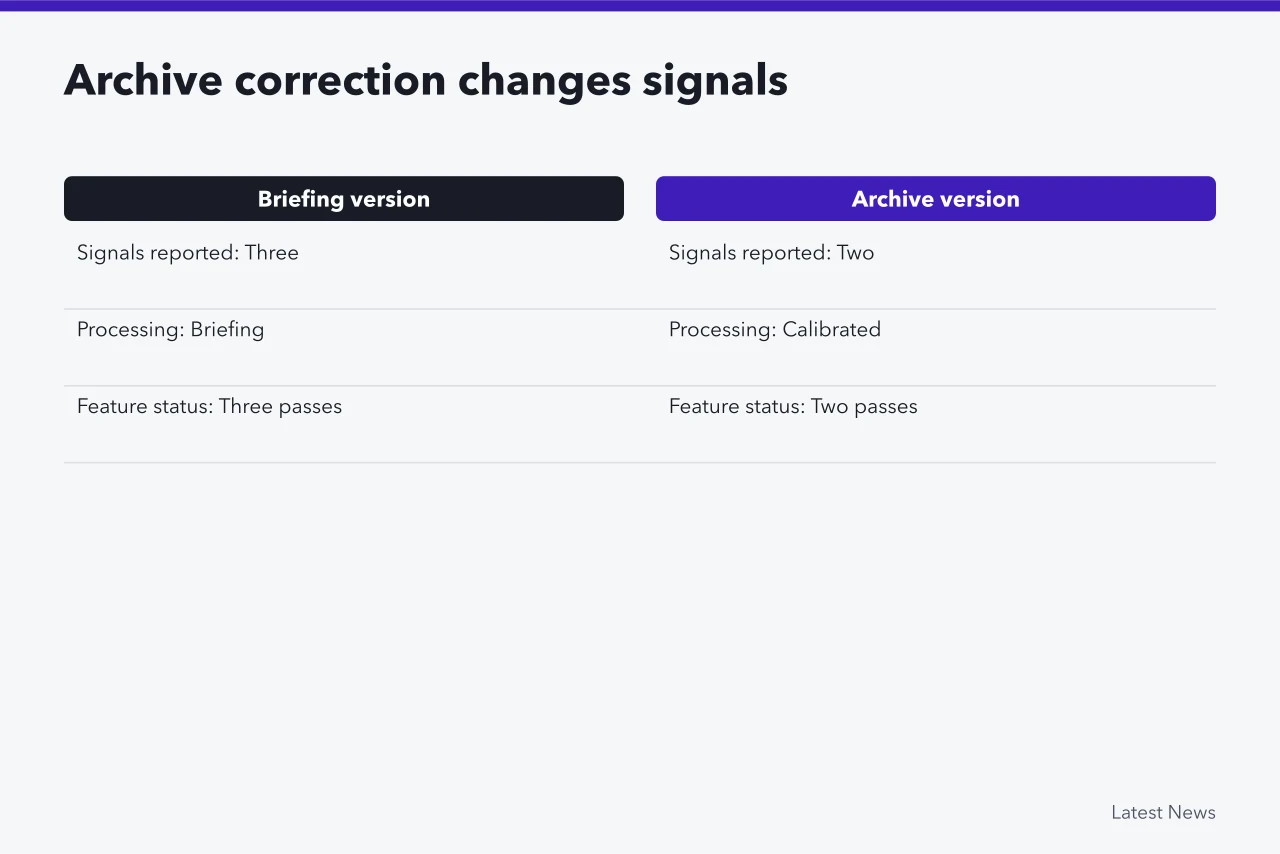
The article is rewritten to say two passes retain the feature, and a dated note explains the change. Version monitoring like this is a standing item on the science announcement reporting checklist.
Paper publication
The later paper reports that the feature is consistent with two possible minerals and cannot distinguish them at the instrument's resolution. The final headline follows that narrower conclusion. The story links measurement, processing, archive, and interpretation without calling ambiguity a failure.
Common questions
Is Horizon Crater a real mission?
No. The mission, asteroid, instrument, data, and timeline are fictional.
Why not call the briefing a discovery?
The team reported a candidate interpretation from limited released material. Full review and alternative explanations remained open.
Did the correction invalidate the entire result?
No. In the fictional case, it changed one of three measurements and narrowed the supported claim.
Is outside comment the same as replication?
No. Replication requires suitable data, methods, and independent analysis or new measurements.