
Guides
Developing news stories need four information states
A guide to developing news stories: how to separate confirmed facts from reported claims, disputes, and open questions, with briefing steps and checks.
What to take away
- Separate what is confirmed, reported, disputed, and still unknown.
- Put the event time beside the publication and update times.
- Give readers enough background to understand the latest development.
- Attribute each contested fact to the source that supplied it.
- Preserve a visible record of material corrections.
Developing news stories change after publication, and many readers arrive after the first version is long gone. A public agency may revise a number, a court may release a filing, or a witness account may be tested against records. The first version cannot contain facts that have not yet emerged. It can still be useful if it marks the limits of current knowledge and gives readers a stable frame.
The job is not to make an early report sound complete. It is to state what the reporting can support at that moment, explain why the event matters, and show which questions remain open. Readers who come to a story already in the news want three things: what led here, who the parties are, and which parts remain genuinely uncertain.
Photo and credit
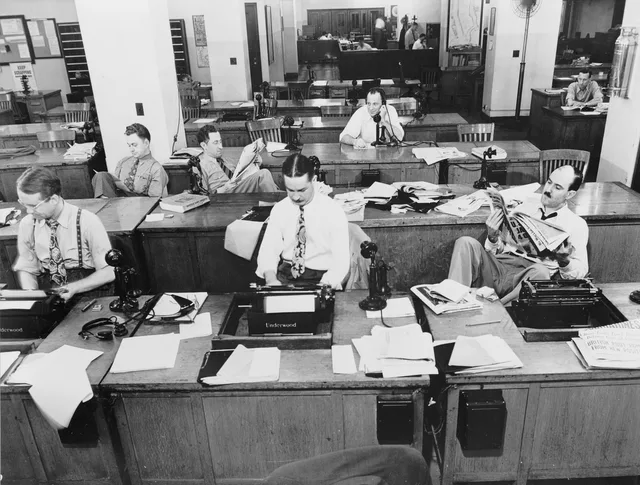
The scene shows note-taking at a press event. It does not prove that the statements made there were accurate or complete.
The four information states
A clear live briefing sorts information before it turns that information into prose.
Four Information States
Confirmed
- Basis
- Named record
- Presentation
- State fact and basis
- Stability
- May be corrected
Reported
- Basis
- Source only
- Presentation
- Keep attribution
- Stability
- May become confirmed
Disputed
- Basis
- Incompatible accounts
- Presentation
- Present each account
- Stability
- May be resolved
Unknown
- Basis
- Not yet answered
- Presentation
- Say answer unknown
- Stability
- May become known
| State | Meaning | Safe presentation |
|---|---|---|
| Confirmed | Supported by a named record, direct observation, or checked source | State the fact and name the basis |
| Reported | Attributed to a source but not independently established | Keep the attribution in the sentence |
| Disputed | Credible parties give incompatible accounts | Present each account and identify the conflict |
| Unknown | The reporting does not yet answer the question | Say that the answer is not known |
The labels become easier to apply with examples.
- Confirmed:a name, date, or figure that a document, direct observation, or a checked source supports.
- Reported:a claim that one official, witness, or outlet has made and that no second source has yet matched.
- Disputed:two credible accounts that contradict each other, such as competing totals or timelines.
- Unknown:the questions that no record or source has answered yet, including the cause, the number of people affected, or the next step.
These labels are working categories, not badges of permanent truth. A reported claim may become confirmed. A confident official statement may later require correction. Keep notes showing why each sentence occupied its category when published. An editor can test those categories against the developing story context checklist before publication: What is the source for this sentence? Is the claim contested by anyone? Has the other side been asked? Which record is missing? Has a material fact changed since the last version?
Build the briefing in layers
The briefing is built in a fixed order, so a reader who arrives late can find the status, the newest development, and the background without reading the whole page.
1. Write a one-sentence status line
Answer three questions: What happened? Where and when did it happen? What is the present consequence? Avoid motive, blame, and precise totals unless they are supported.
Build the Briefing in Layers
- Write a one-sentence status line
- Add the latest verified development
- Explain the background
- List the open questions
- Add an update note
2. Add the latest verified development
Place the newest material near the top, but give it a time. "Officials said Tuesday" is weaker than a full local date and time when events are changing by the hour. If a source refers to another time zone, state which zone applies.
3. Explain the background
Readers arriving through search or a shared post may know nothing about the earlier stages. A compact background section should identify the main people or institutions, the prior event that led here, and any rule or process that controls what happens next.
4. List the open questions
An open-question box disciplines both reporter and reader. It can cover an unconfirmed cause, a missing filing, the source of a figure, or the date of the next decision. Delete a question only when the answer is reported in the article.
5. Add an update note
An update note should say what changed, not merely that the page was updated. A material correction needs a separate, plain label. Silent cleanup is suitable for a typo that did not alter meaning, but not for a wrong name, number, place, quotation, or sequence.
Audience research gives the visible note a second justification. The Reuters Institute report on strategies for building trust in news examines what audiences in four countries say they want from journalism they can trust.
Transparency initiatives are one strategy it studies. The report cautions that no single fix works for every group, and it measures perceptions, not any outlet's accuracy.
Match the format to the reader's need
People use developing coverage differently: one wants the newest confirmed fact, another needs definitions and history, and a third seeks the sequence of official decisions.
The Reuters Institute's account of live coverage identifies distinct needs for updates, context, and explanation, and describes tools that help readers orient in a long stream. Its discussion of breaking-news live blogs supports using different components for those different tasks. It does not establish one mandatory layout for every newsroom.
The three formats answer different reader questions. An event brief answers what just happened, who is involved, and when. An issue brief answers why the topic is in the news and what background a newcomer needs to follow it. An accountability brief answers what a person or institution did, what standard or rule applies, and what remains unresolved. Naming the question first keeps a brief from promising an answer it does not give.
A practical package can contain:
- a short status summary;
- a reverse-chronological update feed;
- a background explainer;
- a source and document list;
- a correction record.
Do not force every item into the lead. The lead should orient the reader. The supporting sections should carry detail.
Language that survives revision
Use verbs that reveal the source of knowledge: records show, the agency reported, the reporter observed, the filing alleges, or the witness said. Avoid verbs that quietly convert an allegation into a fact.
Numbers need both a source and a reference point. State whether a total is preliminary, cumulative, estimated, seasonally adjusted, or limited to a named area. If two agencies count differently, explain the definitions before comparing their figures. The statistical claim checklist runs those checks in a fixed order: where the figure came from, what period and area it covers, how each term is defined, and whether the number is preliminary or final.
Names and roles can change during a story. Store the full name, title at the time of the event, and source for the identification. Do not infer identity from a social profile alone.
A compact publication test
Before publishing, ask:
- Does every sentence carry the label its evidence supports?
- Is the newest verified change given a date and a source?
- Does a first-time reader get the background needed to follow the story?
- Are the open questions still open, or has one been answered?
- Does every contested claim name the source that made it?
- Is there a visible note for each material correction?
Compact Publication Test
- Every central fact has visible basis
- Allegations labeled as allegations
- New reader understands earlier event
- Event, publication, update times distinguishable
- Uncertainty and disagreement stated plainly
- Correction visible if central fact changed
Common questions
How often should a developing story be updated?
Update when verified information changes the reader's understanding. A fixed schedule can help newsroom coordination, but it should not produce empty updates.
Should an old lead be deleted after a major change?
Rewrite the lead to reflect the current state. Preserve a clear update or correction note when the change affects a material fact.
Is an official statement automatically confirmed?
No. It confirms what the official or agency said. The underlying claim may still require records, observation, or independent reporting.
What belongs in the background section?
Include the prior event, main actors, governing process, and definitions a first-time reader needs. Leave out history that does not affect the present story.
In this guide
- Build a news timeline: the Dobbs opinionBuild a news timeline using the Dobbs opinion as a case study: separate the leaked draft's date, its public release, and the Court's final ruling.
- 6 points worth checking on news briefing formatsNews briefing formats checked against six points: main question, time frame, core evidence, typical order, update trigger, and main risk.
- Developing story checklist: fairness, harm, and the final readDeveloping story context checklist for facts, attribution, chronology, definitions, affected people, uncertainty, fairness, corrections, and updates.