Guides
How to Read a 10-K Annual Report for Red Flags: Risk Factors, MD&A, and Footnotes
Read a 10-K annual report for red flags by checking risk factors, MD&A and footnotes. Four disclosure mistakes that stay hidden for quarters.
What to take away
- A 10-K is a compliance document, not a pitch. The useful material sits in Item 1A risk factors, Item 7 MD&A, and the notes to the financial statements.
- The four failures below share one cause: the reader trusts the headline numbers and skips the language around them.
- At least one of these problems, the changed accounting estimate, can sit invisible for four to eight quarters before it shows up as a restatement or a margin collapse.
- Every claim here traces to a filing you can pull yourself on EDGAR company search and check against the SEC investor bulletin on 10-K parts.
The costly one: reading the income statement first
The situation: an investor opens the 10-K, flips to the consolidated statements of operations, sees revenue up 18 percent, and closes the file. The MD&A section, which explains why revenue moved, never gets read.
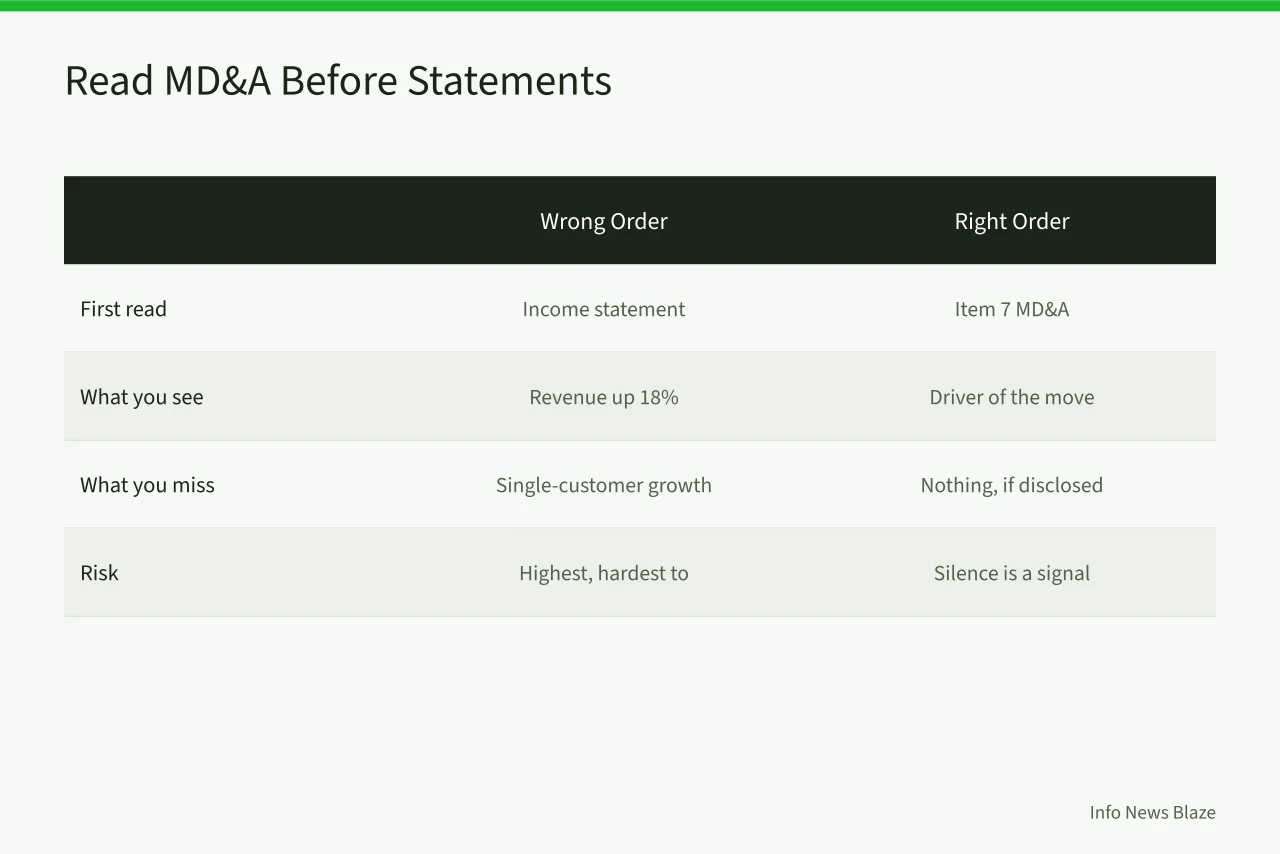
The consequence: the growth turns out to come from a single customer, or from a price increase, or from a segment the company is about to exit. None of that is hidden. It is disclosed, usually in plain sentences, in Item 7.
The prevention: read MD&A before the statements. Item 7 is management's own account of what changed and why, and the Regulation S-K interpretations spell out what companies must address there. If revenue rose and MD&A does not explain the driver, that silence is itself a signal.
This mistake is the most expensive because it is the easiest to make and the hardest to notice. Nothing in the filing flags it. The reader flags it, or does not.
The ones that look fine at first
Two failures survive a careful first pass because the numbers agree with each other.
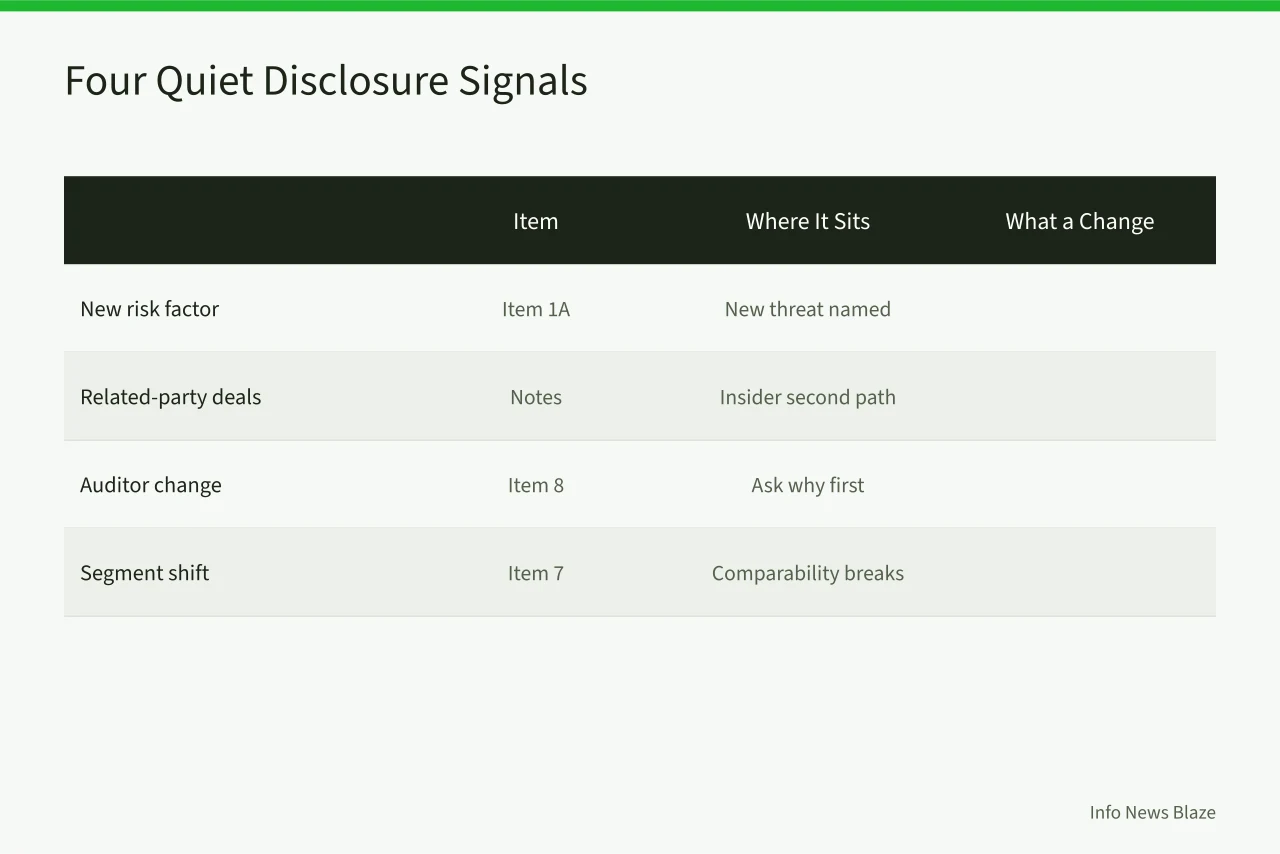
Boilerplate risk factors. Item 1A runs for pages and reads like every other company's. The tell is a risk factor that appears for the first time this year, or one whose wording tightened. A new paragraph about customer concentration, supply chain dependence, or litigation is a change in what management worries about. Compare this year's Item 1A against last year's line by line. The SEC filings explainer walks through how each form differs, which helps when you line up a 10-K against the 10-Qs that followed it.
Related-party footnotes. Sales to an entity owned by the CEO's family, a loan to an officer, a lease from a director. These are legal and disclosed. They also tell you who benefits if the company does well, and they belong on any checklist.
| Item | Where it sits | What a change means |
|---|---|---|
| New risk factor | Item 1A | Management now sees a threat it did not name before |
| Related-party deals | Notes to financial statements | Insiders have a second path to value |
| Auditor change | Item 8 and the audit report | Ask why before you ask what |
| Segment reporting shift | Item 7 and segment note | Comparability across years breaks |
The one that only shows up later
The situation: a company changes an accounting estimate. Useful life on equipment, expected returns on pension assets, the allowance for credit losses, the timing of revenue recognition on multi-year contracts. The change is disclosed in a footnote, often in a single sentence.
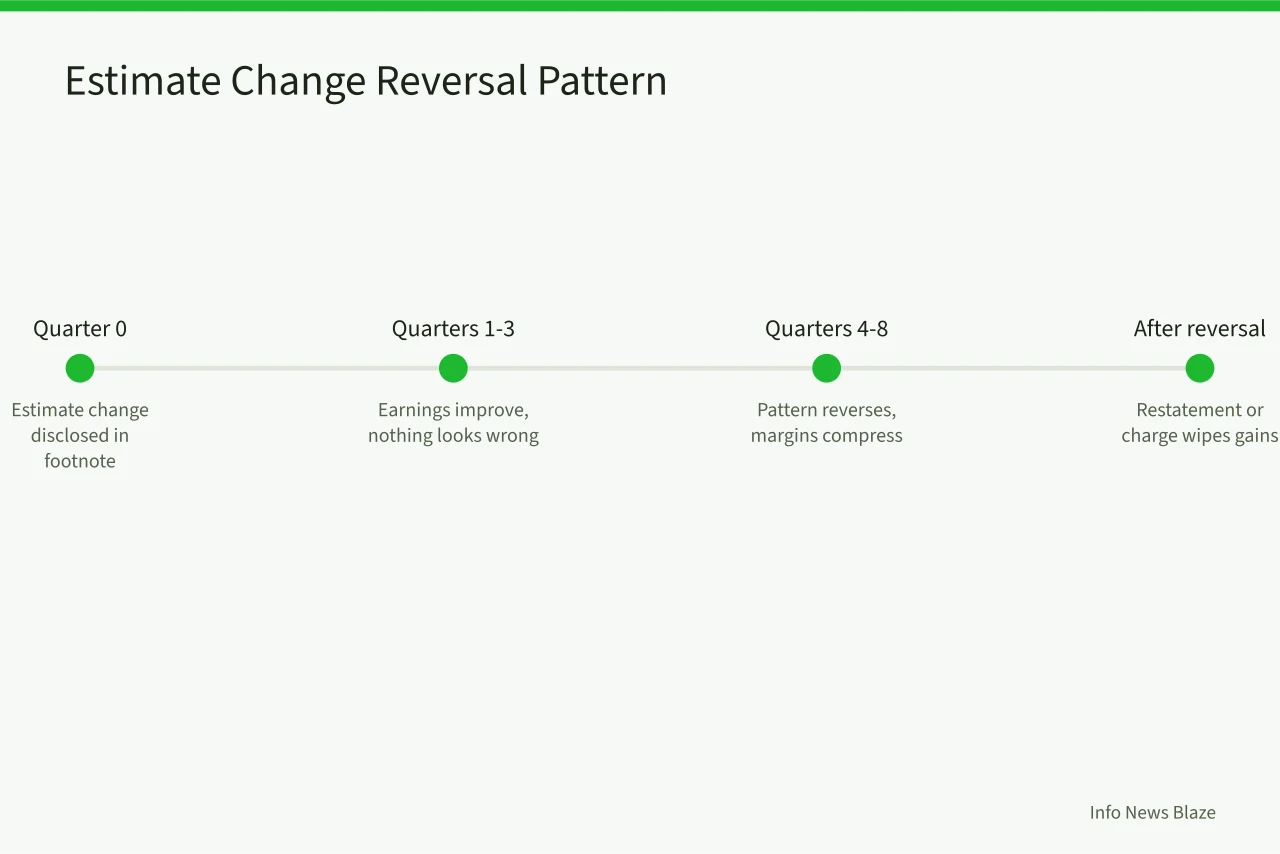
The consequence: reported earnings improve this quarter, and next quarter, and the quarter after. Nothing looks wrong because nothing is wrong yet. The estimate was legal under U.S. GAAP and the auditor signed off. Then, four to eight quarters later, the pattern reverses. Margins compress, a restatement lands, or the company takes a charge that wipes out the earlier gains.
The prevention: keep a running note of every estimate change and its dollar effect. Ask whether the change moved earnings in the same direction as the company's guidance. A single estimate change that flatters results is common. Three in a row is a pattern, and the pattern is the red flag.
This is the failure that stays invisible for months or seasons. It leaves no trace in the headline numbers until the reversal, and by then the stock has already moved.
What they have in common
Each failure is a reader problem dressed as a disclosure problem. The SEC requires the information. The company provides it. The reader skips it because the filing runs 200 pages and the summary is easier.
A working checklist for one company, one year:
- Pull the 10-K and the prior year's 10-K from EDGAR side by side.
- Diff Item 1A and mark every new or reworded risk factor.
- Read Item 7 before the financial statements and note any driver management does not explain.
- List every accounting estimate change and its stated earnings effect.
- Scan the related-party and subsequent-events notes for names you recognize.
That is roughly two hours of work per company. The alternative is trusting a headline number that a filing was never designed to support on its own. Readers who want the same discipline applied to other public records can see how it works in the guide to FOIA requests and what agencies withhold, where the same habit of reading the disclosure rather than the summary pays off.
Common questions
How far back should I compare 10-Ks? Three years is the practical minimum for risk factors and MD&A, since that window covers a full business cycle for most companies. Five years is better if the company has changed segments or made large acquisitions.
Is a risk factor that never changes a warning sign? Sometimes. Identical language across years can mean the risk is stable, or that the company is copying prior filings. Check whether the underlying exposure, such as customer count or debt maturity, actually stayed flat.
Do estimate changes always signal trouble? No. Most are routine and defensible, and auditors review them. The signal comes from direction and repetition: changes that consistently raise reported earnings deserve a closer look.
Where do I find the auditor's opinion? In Item 8, with the financial statements. A change of auditor, or a qualified opinion, is disclosed there and in the 8-K that announced the change.