Guides
How to Read a City Council Agenda: Consent Calendar, Backup, and Public Comment
Learn to read a city council agenda: what the consent calendar means, where backup materials live, and how public comment rules shape what you see.
What to take away
- A city council agenda lists items for decision, but the consent calendar often passes many routine items in one vote.
- Backup materials and staff reports carry the actual reasoning behind each item.
- Public comment rules vary by city and determine when and how you can speak about an item.
- Measure consent share, the percentage of action items on the consent calendar, to decide how much to dig into backup.
- If consent share passes 70 percent, pull the backup for each item that affects you.
What to measure
Consent share is the percentage of action items on a regular meeting agenda that appear on the consent calendar. Count the action items, count the ones placed on the consent calendar, and divide. A city with 20 action items and 15 on consent has a consent share of 75 percent.
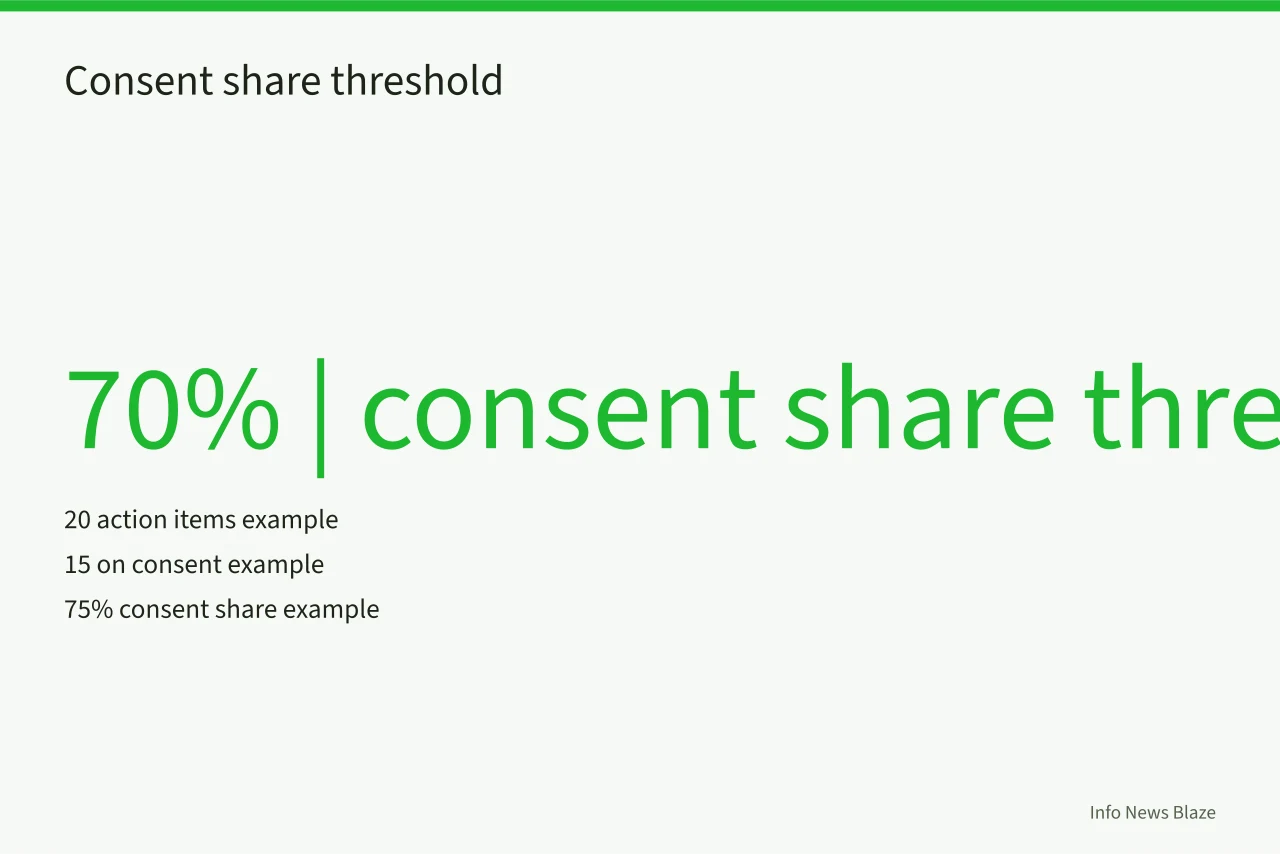
That number gives you a reading of how much of the meeting is routine. Use 70 percent as a threshold for acting. If consent share is above 70 percent, assume many decisions will pass without individual discussion and obtain the backup for the items that touch your street, utility bill, or local permit. When an agenda item says it implements a federal bill, see How to Track a Federal Bill to check its status before the vote.
How to read it
A typical U.S. municipal agenda has four parts: call to order, consent calendar, action items, and public hearings. Use this table to find what each part shows.
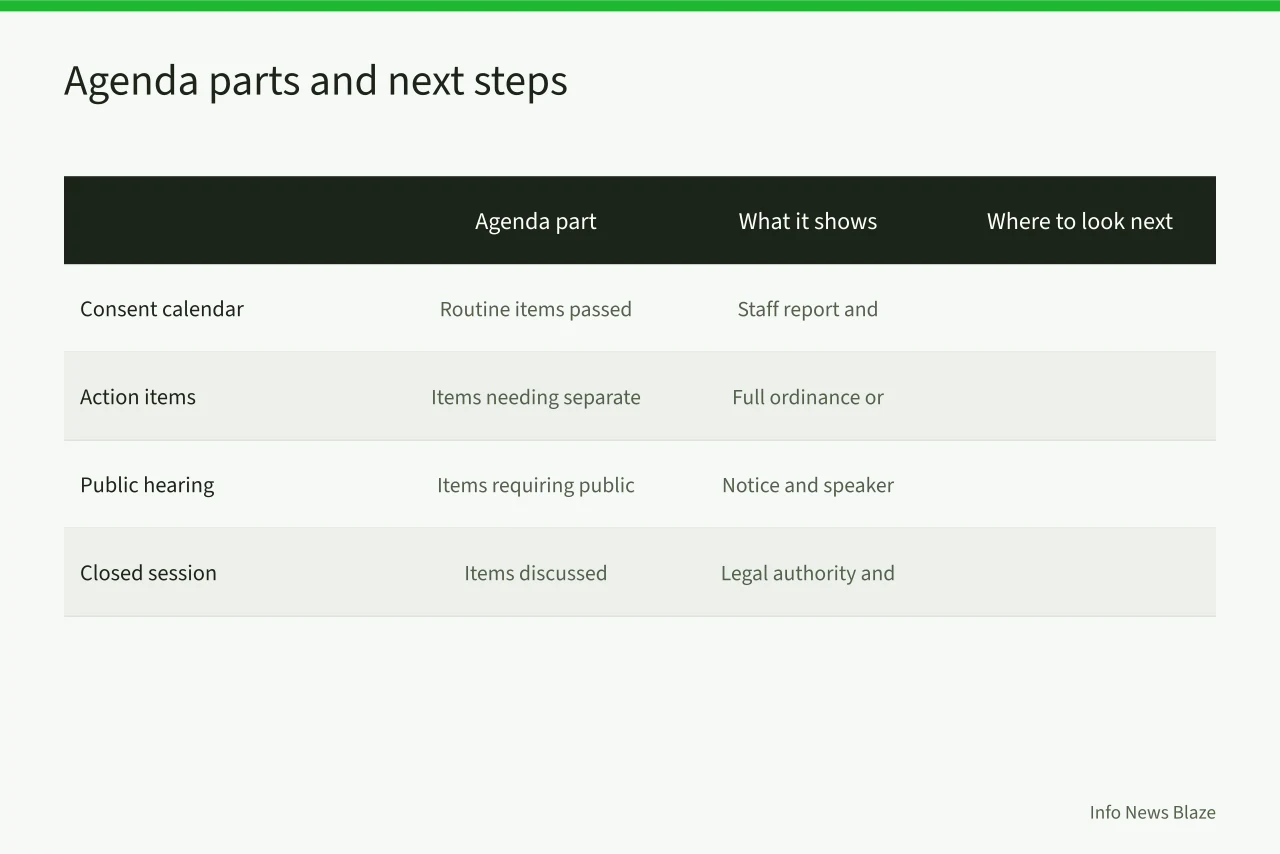
| Agenda part | What it shows | Where to look next |
|---|---|---|
| Consent calendar | Routine items passed in one vote | Staff report and backup |
| Action items | Items needing separate discussion and vote | Full ordinance or resolution text |
| Public hearing | Items requiring public testimony before a vote | Notice and speaker sign-up rules |
| Closed session | Items discussed privately | Legal authority and later minutes |
Minutes are the official record, not the agenda. Search for them on the city clerk's page by date and keyword. Many cities use Legistar, Granicus, or CivicPlus systems, so try the city's own portal before a web search.
Public comment rules in many U.S. cities limit each speaker to two or three minutes. Check your city clerk's page before you arrive.
Some cities also require you to submit a speaker card before the item is called. If you miss that window, you may lose the chance to speak even if you attend.
Before you rely on an agenda summary, read the actual New York City council bill as explained in that guide. The summary can leave out a condition or a sunset date.
Backup materials are the packet of staff reports, maps, ordinances, and fiscal notes linked from the agenda. Read the staff report's fiscal note before you read the summary; it often states the dollar effect and the source of funds.
Example agenda reading
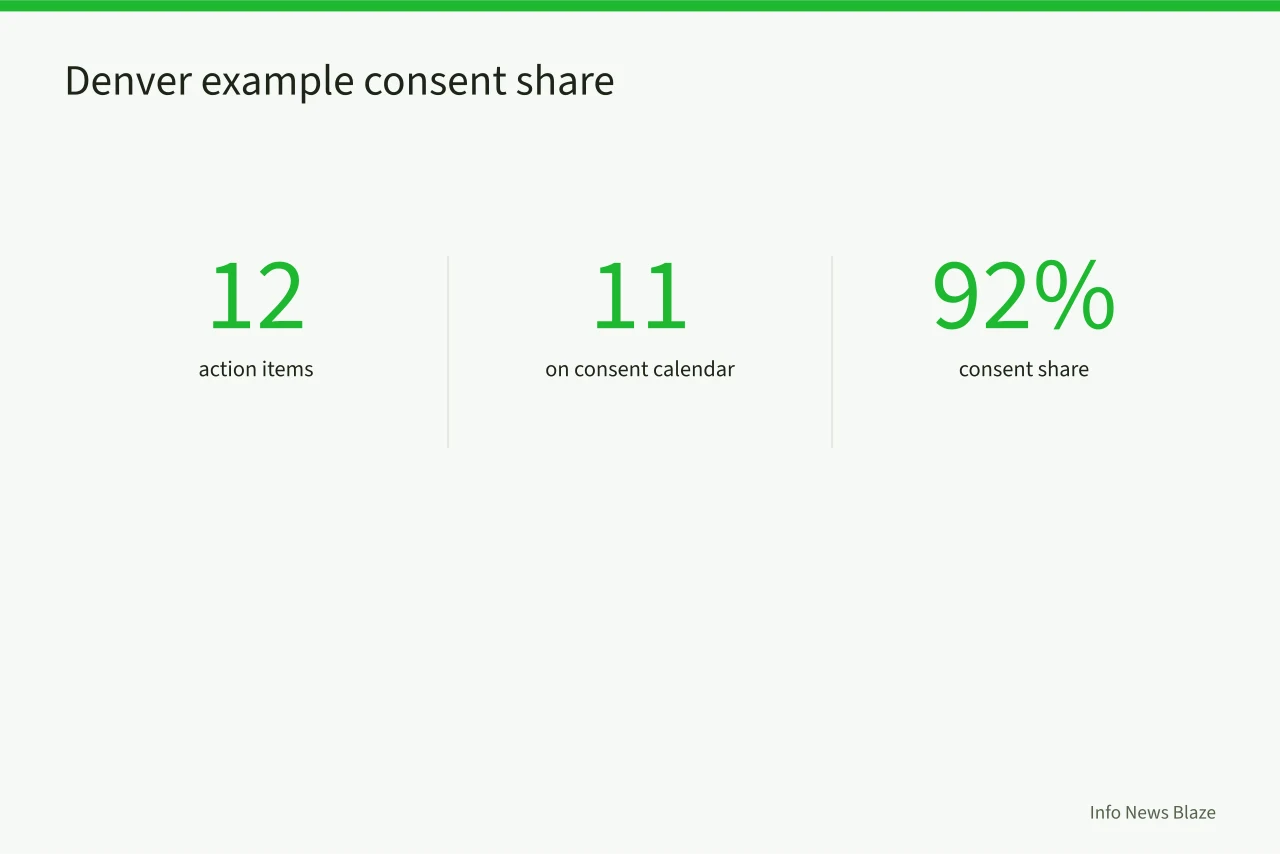
Suppose a Denver Monday agenda has 12 action items. The consent calendar lists 11: a liquor license renewal, a street closure, a contract amendment. The action item list has one item, a zoning change. The consent share is 11 of 12, or 92 percent, above the threshold. Pull the backup for the zoning item even if the liquor license does not affect you.
What it cannot tell you
Consent share is a blunt measure. It cannot tell you which items were pulled from the consent calendar by a council member or a member of the public. It also cannot tell you whether any discussion happened in a committee before the meeting. A low consent share may mean more debate, but it may also mean the clerk splits items for procedural reasons. Consent share also says nothing about whether public testimony changed a vote.
Audit items on a council agenda can signal performance problems. How Chicago's inspector general audits shows how those reports are built, but the agenda alone rarely says which finding led to which agenda item.
Attribution and its limits
Attributing a local outcome to a single council vote is often too simple. A new fee may appear on an agenda after years of staff work, a state rule, and a budget cycle. The council vote is one step, not the whole cause. Avoid treating consent share as proof that the council ignored an item; the backup may show a prior committee hearing.
When to stop measuring and decide
The agenda, backup, and minutes together give you enough to decide whether to attend, write, or speak. A decision to act does not require a perfect reading of every staff memo. Set a time limit for your review, such as 30 minutes for a regular meeting.
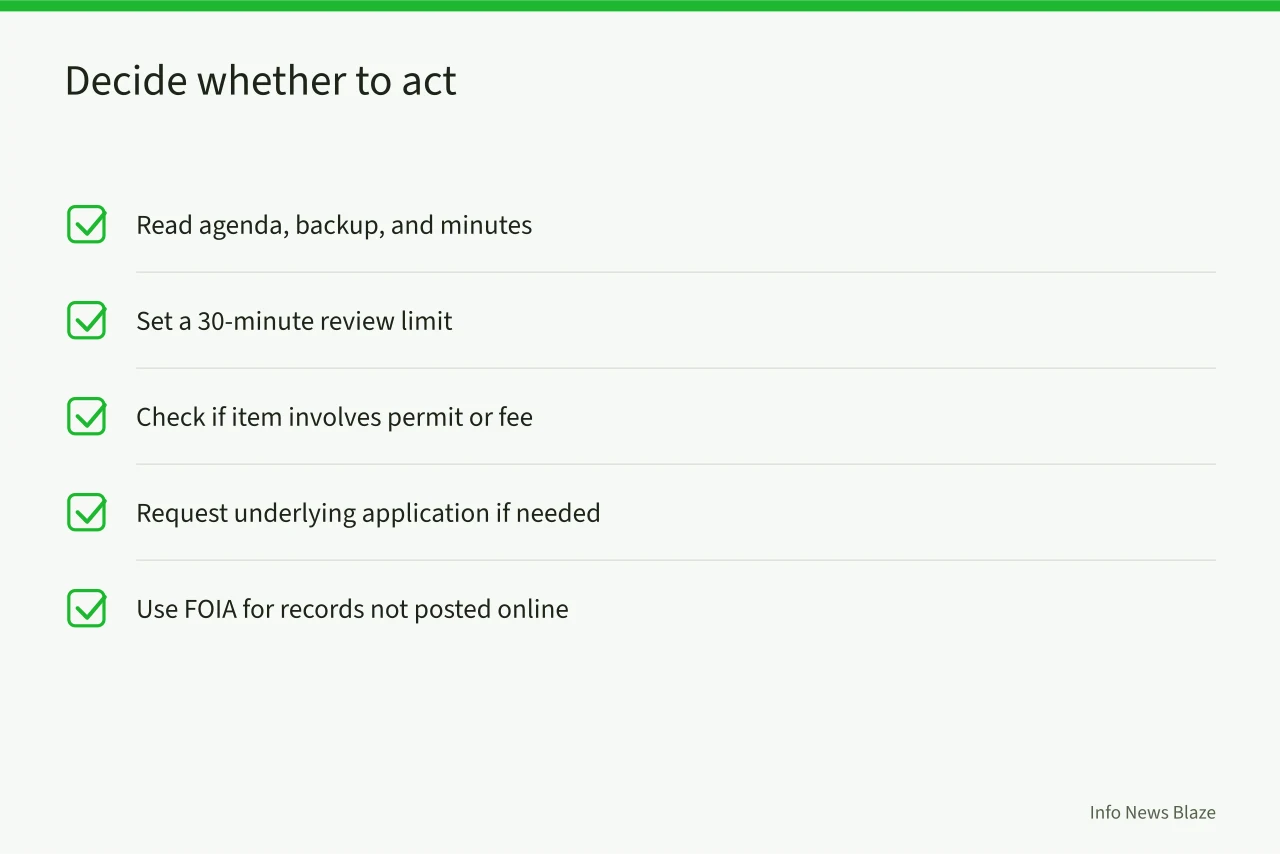
If the item involves a permit or a fee, you may need the underlying application as well. When you need to request records that are not posted online, see How FOIA requests work for the federal baseline and then apply your state's equivalent.
Common questions
What does consent calendar mean?
A consent calendar groups routine items for a single vote, often without separate discussion; any council member can usually pull an item for individual consideration.
How do I search for council meeting minutes?
Start on the city clerk's page, search by date and keyword, and use the portal's citation if you need to quote the record.
What are typical public comment rules?
Most cities require you to sign up before the meeting, limit comments to two or three minutes, and restrict comments about items not on the agenda.
What if an agenda item cites a federal bill?
City council records are not federal; the FOIA FAQ applies to federal agencies, not city councils. The GovInfo bill help page explains how to locate bill text and history for federal comparisons.