Features
Case study: a fictional border closure and safe-passage claim
A fictional border closure shows how a desk separates an order from observed passage, tests a safe-corridor claim, and keeps movement totals in their own units.
What to take away
- An order, an observed closure and a party claim are three separate facts, logged separately.
- A corridor is a proposal until both sides publish matching route, window and terms.
- Movement counts stay in their own units, each with source and cutoff.
- Access incidents are recorded as incident, place, policy, impact and response.
- Names, routes, checkpoints and family interviews stay out of the copy.
At 7 a.m., the fictional state of Lydora announces that two crossings with fictional Norvia will close to private vehicles at noon. Freight, emergency medical transfers and accredited humanitarian movements are listed as exceptions. A conflict party later claims a safe corridor will open elsewhere. Every name, place, time and figure below is invented.
Verify the order
The desk obtains the signed order, the agency publication, the effective time, the named crossings, the exceptions and the review date. It calls both crossing authorities.
One says private vehicles stopped entering early because traffic had backed up. The other stays open until noon. The headline does not say "border sealed."
The claim-ledger method comes from the international conflict reporting guide.
Test the corridor claim
The party's statement gives no map, no duration and no agreement from the other side. The article calls it a proposal, not an operating corridor.
The ICRC explainer on humanitarian corridors defines safe passages as agreements between conflict parties for a limited time and area, with civilian consent and continued protection. The desk asks who agreed, which route, which window and what security guarantees exist. Corridor overclaims and their fixes appear in international conflict reporting problems.
Count movement carefully
An aid group reports 4,000 "movements" in three days. A border agency reports 2,700 people processed. The two are not added. The first can include repeat movement. The second covers registered crossings at specified points.
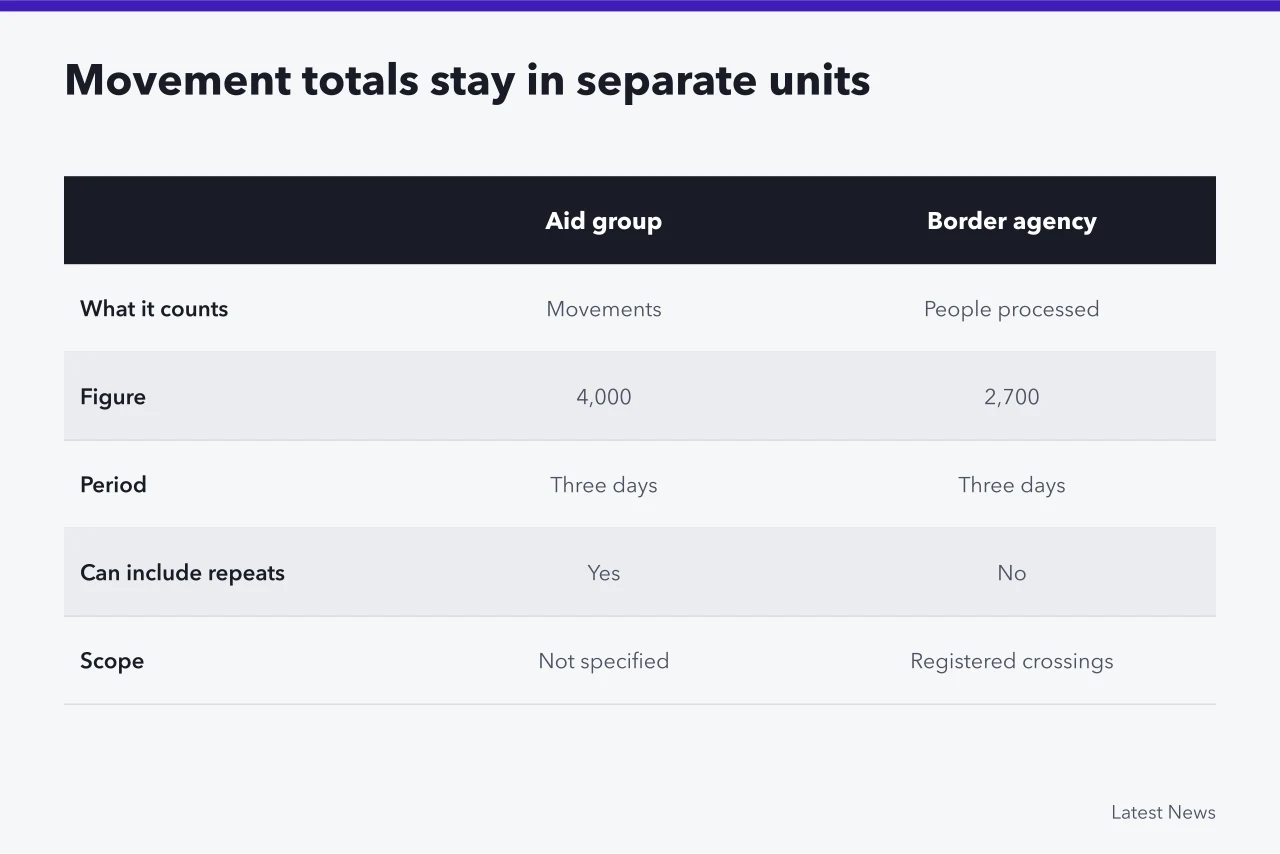
The desk runs the two figures in separate sentences, each with its source, unit and cutoff, so readers can see they measure different things. A later tally in a third unit, such as households, gets its own attributed line rather than a conversion. Unit definitions for such rows are compared in conflict displacement and protection terms.
Editors keep one row per category, each with its own source and cutoff:
| Row | What it counts | Source |
|---|---|---|
| Scheduled opening | Order states a time | Signed order |
| Observed opening | Barrier lifted, seen | Reporter on scene |
| Individual processing | People registered | Border agency |
| Vehicle processing | Vehicles cleared | Border agency |
| Aid cargo | Trucks passed | Aid organization |
This keeps a planned exception from being reported as completed passage, and stops freight totals from being read as people.
The desk publishes no identifiable family interviews at the staging area and strips location metadata. A route photograph waits until travelers have cleared the area.
Verify access constraints
At 4 p.m., two aid organizations say paperwork delays kept trucks from passing under the exception. The story attributes their accounts and seeks the border agency's response.
ReliefWeb's humanitarian access topic page defines access as aid workers' ability to reach people in need, and affected people's ability to reach assistance. It collects reports counting access incidents by place and period. The desk records incident, place, policy, impact and response rather than calling every delay a blockade.
Update the status
At 6 p.m., both parties publish matching route and time terms for a four-hour passage the next morning. The headline changes to say an agreement was announced.
A reporter confirms opening only after watching movement from a safe location and checking with participating humanitarian organizations. The verify-then-announce rhythm matches the flash flood warning case, where expiration and reopening stayed separate.
The next day the passage closes after three hours. The story records actual operation separately from planned duration and states how many people the processing authority counted, without names.
Common questions
Are Lydora and Norvia real?
No. Every entity, place and event in this example is fictional, and the figures are illustrative only. Nothing here describes a real border or conflict.
Is an announced corridor automatically safe?
No. Agreement terms, civilian consent, security guarantees, communication and implementation all have to be checked. Until both sides publish matching route and window terms, the desk calls it a proposal.
Why not add movements and people?
They are different units and may overlap. Adding them produces a number no source reported. Keep each in its own row with its source and cutoff.
When can the desk say a border is closed?
When the statement matches the defined crossings, categories, effective time and exceptions, and observation confirms it. An order alone supports "ordered to close," not "closed."