
Guides
Part of Public records reporting: a guide to finding and reading documents
How to read an official document without losing its context
Official document reading method for provenance, version, authority, definitions, footnotes, attachments, omissions, comparisons, citations, and reporting limits.
What to take away
- Identify the document before interpreting its claims.
- Distinguish draft, proposed, final, signed, and amended versions.
- Read definitions, footnotes, appendices, and attachments.
- Separate the author's claim from independently established fact.
- Cite enough record detail for another person to retrieve the same item.
An official-looking PDF can be a draft, an attachment, a scanned copy, or a page removed from a larger record. Begin with provenance. Interpretation comes later. The wider workflow around searches and requests sits in the public records reporting guide.
This method works for reports, orders, audits, minutes, contracts, policy memos, and many archival records. Specialized legal or scientific documents may need expert review.
Photo and credit
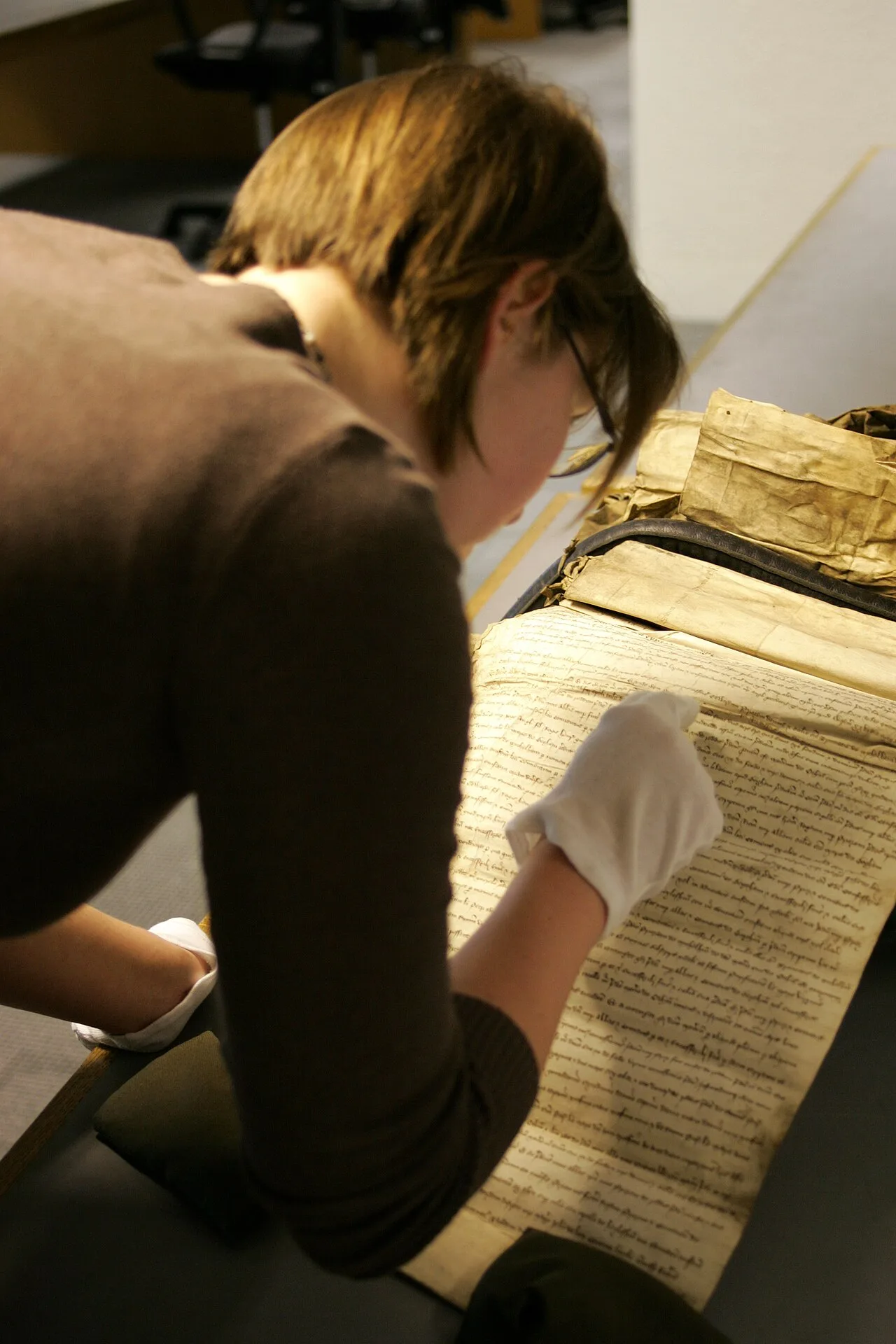
The photograph illustrates close examination of a historical item. Gloves are not a universal handling rule for every archive or material.
Step 1: identify the object
Record the full title, creator, date, identifier, repository, file name, page count, and access date. If the copy came from an email or shared drive, find the issuing body's version when possible.
Some document families have a designated home. Oversight.gov's description of its collection says the site holds reports from participating federal offices of inspector general, which upload their own data, and that it serves as the official site for the inspector general community. Retrieving the copy there ties a watchdog report to its issuing office.
Check whether the record is complete. A page marked "Attachment B" implies other material. A table of contents can reveal missing sections. Pagination such as 14 of 62 warns against treating one page as the whole report.
Step 2: determine its status
Look for words such as draft, proposed, interim, final, executed, filed, corrected, amended, or superseded. Check signatures, approval blocks, docket entries, and publication history.
A draft can show what an author considered. It cannot be quoted as the agency's final decision. A signed contract may later be modified. A final report may still receive an errata sheet. The official record types comparison lists the common misreadings for each class.
Create a short version note:
Final report, dated May 4, downloaded from the issuing office on May 8; no amendment listed on the record page as of access.
Step 3: locate authority and purpose
Ask why the document exists and what power its author has. An inspector may make findings but not impose a penalty. A staff memo may recommend action but not approve it. Meeting minutes record an institution's account of a meeting; they are not a transcript unless identified as one.
Read the scope statement. It may limit the covered locations, period, sample, transactions, or questions.
Step 4: map its internal structure
Before highlighting quotations, list the main parts:
| Part | Reading question |
|---|---|
| Executive summary | Does it match the detailed findings? |
| Definitions | Do common words have special meanings here? |
| Method | How were records, samples, or interviews selected? |
| Findings | What evidence supports each conclusion? |
| Limitations | What was not tested or available? |
| Appendices | Do tables or attachments alter the summary? |
Footnotes often carry exceptions, source notes, and changes in definition. Read the note before reporting the number attached to it.
Step 5: distinguish voices
Mark whether each statement is:
- the document author's finding;
- a claim quoted from another person;
- a summary of another record;
- a legal allegation;
- a party's response;
- your own calculation.
An audit that quotes a manager is evidence that the manager made the statement. It does not automatically establish the statement's truth. Attribution states of this kind are the working categories of developing news stories.
Step 6: reproduce the finding
For a number, trace the inputs, unit, period, exclusions, and formula. For a legal or administrative decision, trace the issue, authority, evidence, reasoning, and ordered action. For minutes, compare the listed motion, vote, and approved action. Numerical findings then face the numbers-and-comparisons section of the developing story context checklist before they carry a headline.
If a result cannot be reproduced, explain what is missing. Do not hide uncertainty with a more confident paraphrase.
Step 7: create a retrievable citation
Good citations help another researcher find the same object. National Archives guidance for congressional records calls for elements such as the record, file unit, series, Congress, record group, and repository, along with identifying details. The National Archives citation guide for congressional records supports recording more than a document title. Its exact format is specific to those holdings.
For a modern online record, keep the issuing body, document title, date, version, identifier, page, stable record URL, and access date.
Step 8: write the limit beside the finding
Use a two-column note while drafting:
| Supported finding | Limit |
|---|---|
| The audit sampled 80 files | It did not review every file |
| The board approved the motion 5-2 | Minutes do not record every discussion word |
| The contract lists a base price | Later modifications may change total spending |
This habit keeps caveats connected to the claims they qualify.
Common questions
Is a government PDF always the official version?
No. Check its source page, status, signatures, identifier, and amendment history.
Should a reporter quote the executive summary?
Only after comparing it with the method, detailed findings, limitations, and any response section.
What if a scan is hard to search?
Use text recognition as a finding aid, then verify quotations against the image. Recognition errors are common with old type, handwriting, and damaged pages.
Why record an access date?
Online records can be replaced or moved. The access date helps identify the version consulted.