Maintenance
Part of Disaster, emergency, and conflict reporting: a practical guide for 2027
Emergency reporting checklist: casualty figures and the live log
Emergency and conflict reporting checklist for safety instructions, maps, source chains, impact figures, casualty records, visual evidence, privacy, and corrections.
What to take away
- Verify current action instructions before publishing background.
- Give every count a source, definition, area, and cutoff time.
- Trace copied claims to their first known source.
- Protect locations and identities when disclosure can cause harm.
- Keep a visible correction and update record.
Use this checklist for disasters, public-safety emergencies, and armed conflict. It does not replace hostile-environment training, local legal advice, or an editor's risk decision. Its sections compress the disaster and emergency reporting guide.
Immediate public safety
- The hazard and affected area are specific.
- The issuing authority is named.
- Issue time, effective time, and time zone are visible.
- The protective action is quoted or faithfully paraphrased.
- Routes, shelters, and services were checked with their operators.
- Access information covers transport, disability, language, medical needs, children, and animals when provided.
- The next official and newsroom update times are stated.
- Obsolete instructions have been removed from prominent positions.
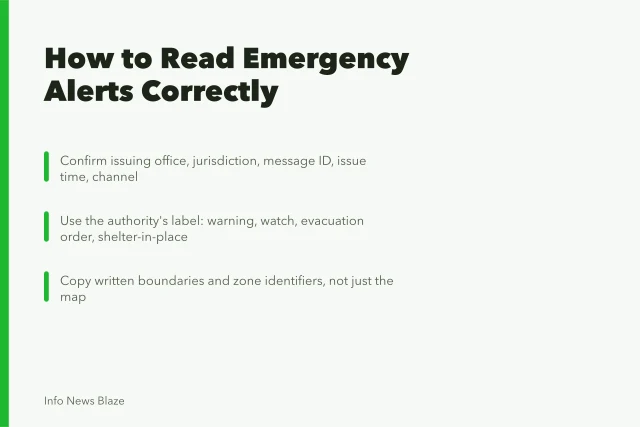
Instruction reading, from issuer to boundary, follows the steps in how to read an emergency alert.
Geographic control
- Written boundaries and zone codes match the map.
- Map title, legend, scale, layer date, and data source were read.
- The article distinguishes the hazard footprint from an administrative order area.
- Road closures are not assumed to be zone boundaries.
- A location is not disclosed if doing so could expose people or operations.
Source chain
- The original statement, post, image, or document was located.
- Each source's role and access are known.
- Reposts are not counted as independent confirmation.
- A party to a conflict is identified as such when reporting its claim.
- Access restrictions and missing checks are stated without speculation.
The Berkeley Protocol on digital open source investigations identifies international standards for online research into alleged violations. The Berkeley Human Rights Center published it with the UN human rights office. It covers gathering, analyzing, and preserving digital information, and protecting witnesses, victims, and first responders.
It was designed for formal investigations, so a newsroom should treat it as a methods reference, not a certificate for its own checks.
Impact figures
- Deaths, injuries, missing people, rescues, evacuees, and shelter registrations are separate.
- Buildings affected, damaged, inaccessible, and destroyed are separate.
- Utility outages identify customers, meters, households, or people.
- The count has an area, period, cutoff time, and version.
- Overlapping local and national totals are not added.
- Ranges and estimates retain their labels.
Each count also faces the first trap in statistics reporting problems: a value reported without its denominator.
Keeping impact counts separate
- Deaths, injuries, missing, rescues, evacuees separate
- Buildings affected, damaged, inaccessible, destroyed separate
- Outages name customers, meters, households, people
- Count has area, period, cutoff, version
- Do not add overlapping local and national totals
- Ranges and estimates keep their labels
Casualty methodology
- Inclusion and exclusion rules are available.
- Civilian, combatant, unknown, direct, and indirect categories are not blended silently.
- Incident date and reporting date remain separate.
- Named records were checked for duplicates and spelling variations.
- The verification threshold is described.
- Unverified reports stay outside the verified total.
- Publishing names will not endanger relatives, witnesses, or survivors.
The UN Digital Library record for the OHCHR guidance on casualty recording calls it the first UN casualty recording methodology publication.
It is a how-to guide for such systems, stressing transparent methods so resulting data and analysis are reliable and usable. A newsroom may not run a full casualty-recording system, but it can disclose whether a cited total names its method.
Visual and audio evidence
- Original file and source page are preserved.
- Location, time, prior use, weather, landmarks, and edits were checked.
- The caption states what the image proves and what it does not.
- Graphic content has an editorial reason and warning.
- Faces, plates, screens, documents, and coordinates were reviewed for risk.
- Translation and transcription received a second check when material.
Headline and live log
- Forecasts are not written as completed impacts.
- Claims are attributed at the point readers encounter them.
- "Confirmed" names the confirmer and standard.
- The headline uses the current area and current count.
- Each material update says what changed.
- Corrections propagate to alerts, captions, social posts, and partners.
Propagating a fix to headlines, captions, newsletters, and social posts is part of the invisible-correction repair in developing news briefing problems.
Common questions
Can the desk publish a range from officials?
Yes. Name the source, method if known, area, cutoff time, and why the range remains uncertain.
Should casualty names be published as soon as they circulate?
No. Confirm identity, notification status, public-interest reason, and risk to relatives and others before publication.
Is satellite imagery enough to confirm damage?
It can document visible change at a time and resolution. It may not establish cause, occupancy, casualties, or conditions hidden from view.
What belongs in the correction log?
Record changes to safety advice, locations, identities, attribution, count definitions, magnitude, and any claim that altered readers' understanding.