Reviews
Before you publish roadside renovation budget notes, fix these six mistakes
Avoid roadside renovation budget mistakes in 2027 by separating scopes, requests, proposals, invoices, contingencies, source dates, and public financial claims.
The most expensive budget error is often not a wrong number. It is a number that has been given the wrong job. A planning request becomes "the budget." A vendor proposal becomes "the market price." An invoice becomes "the total project cost." A contingency becomes evidence that a problem has been found.
Those shortcuts make public reporting hard to correct later. This guide is for keeping a roadside-renovation budget note honest from the start. It is not an estimate, inspection, funding decision, or professional opinion about a particular property.
What to take away
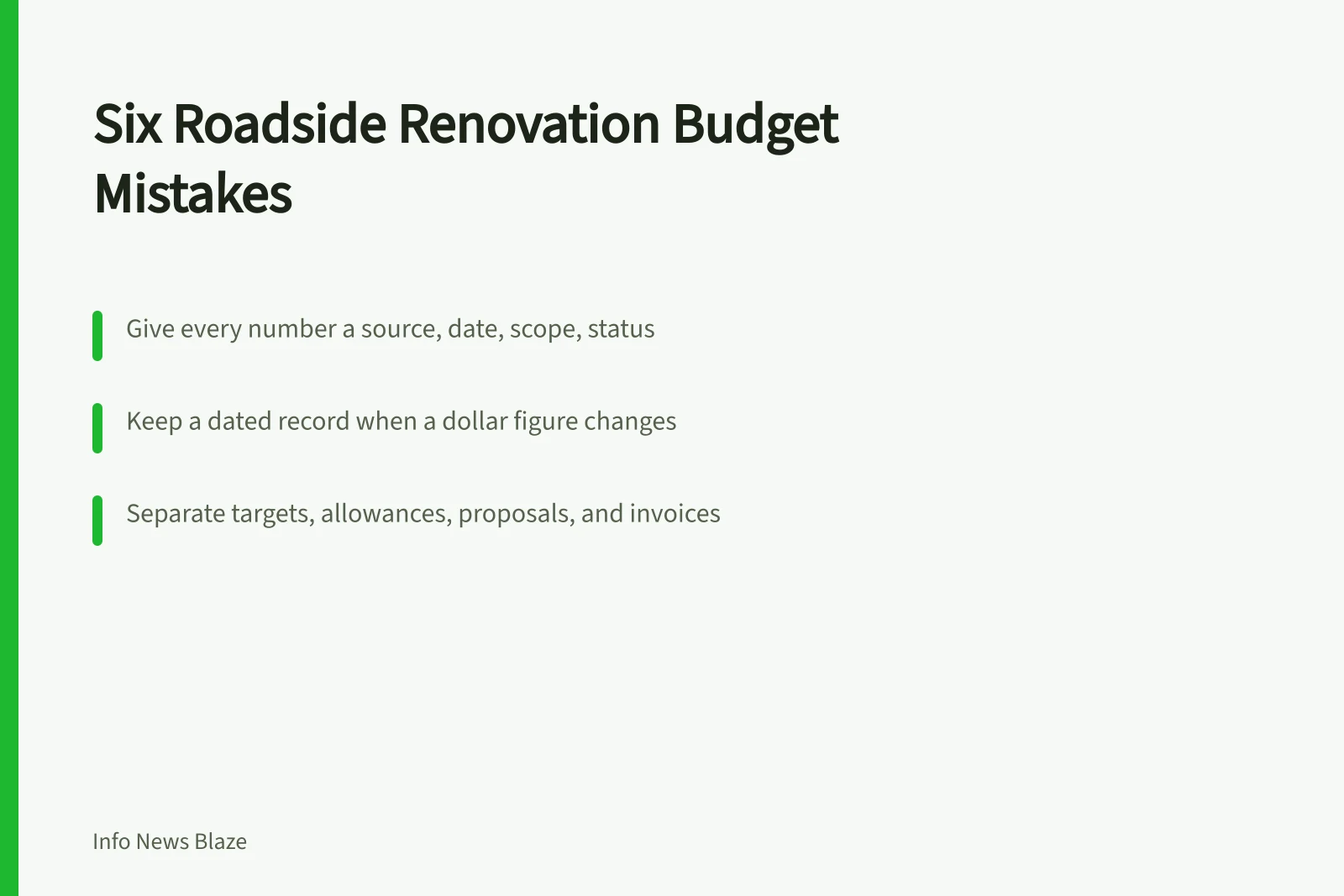
- Give every number a source, date, scope, status, and stated limit.
- Make a separate record when a figure changes meaning or project stage.
- Do not solve a missing scope with a generic percentage or borrowed price.
- Correct the article when a source is wrong, outdated, or more limited than the claim.
Mistake one: treating all amounts as budgets
The word "budget" can hide several kinds of evidence. They should not be reported as if they mean the same thing.
Figure Types and What They Record
Figure type
- Fundraising target
- Amount hoped for
- Planning allowance
- Funds for next step
- Contractor proposal
- Price at a date
- Award notice
- Support for activity
- Invoice
- Work billed
Records
- Fundraising target
- Money committed
- Planning allowance
- Cost is known
- Contractor proposal
- Typical project cost
- Award notice
- Full project paid
- Invoice
- All work complete
Do not infer
- Fundraising target
- Planning allowance
- Contractor proposal
- Award notice
- Invoice
Write the label into the sentence, not only the spreadsheet. "A grant award supports the stated planning activity" is clear. "The project has a $50,000 budget" may be false if the source shows only an application request or a limited award.
The GAO Cost Estimating and Assessment Guide describes estimates as needing a defined purpose, technical basis, assumptions, data, methods, and updates. It concerns government cost estimating, not one roadside building. The useful editorial point is that the label and basis are part of the figure. Without them, readers cannot know what the number was designed to answer.
Mistake two: hiding scope gaps inside a total
An article may have a precise-looking number even though the source leaves out access, testing, permits, design, utilities, insurance, site conditions, or later operations. Precision in the currency field does not repair a missing scope.
Use a scope card beside every public figure:
Scope Card for Every Figure
- Who issued the source and when
- What work or decision it names
- Which locations, features, phases included
- Which exclusions or assumptions stated
- Requested, offered, paid, or considered
- What would change the amount
If the source does not answer an item, write "not stated in the source." That is more useful than borrowing a contingency percentage from another project. It tells a future editor where the record ends and why a broader claim would be unsupported.
Mistake three: using a review allowance as a diagnosis
Budget notes sometimes say that an allowance exists for a materials question, a condition review, or a technical opinion. That does not mean the issue has been confirmed. The language needs to preserve the difference between a question and a conclusion.
Review Task vs Confirmed Condition
Source records
- Initial review
- Lead remediation included
- Question raised
- Issue proved
- Precaution step
- Condition confirmed
- Allowance line
- Settled fact
Unsupported wording
- Initial review
- Question raised
- Precaution step
- Allowance line
EPA's lead-safe renovation guidance for do-it-yourselfers covers lead-dust risks and safe practices for some work in pre-1978 homes and child-occupied facilities. It does not prove lead exists at a roadside commercial property or set a review's price.
The source backs one narrow article statement.
When documented property and work facts raise a covered question, describe the review or precaution the source supports.
Avoid phrases such as "lead remediation is included" when the source only records an initial review. The same rule applies to structural, electrical, fire, environmental, and access questions. A budget line can fund a step toward understanding an issue. It does not make the issue a settled fact.
Mistake four: losing the record behind a correction
When an article changes a dollar figure, the old note should not simply vanish. Keep a dated record of the source and explain why the new wording differs. A revision can result from a scope change, a corrected document, an expired proposal, a new decision, or a clearer statement from the issuer.
The National Archives explanation of primary sources calls primary sources firsthand evidence from the time under study.
In a budget file, a dated award notice, signed proposal, invoice, meeting record, or official decision can directly record what was said or done then. It may still be incomplete or superseded. Its value: an editor can check a later summary against the original record.
Use a correction entry that contains these elements:
Correction Entries to Retain
Change
- Amount misread
- Original and corrected
- Proposal expired
- Proposal and date
- Scope narrowed
- Earlier and revised scope
- Funding changed
- Notice or decision
Record to retain
- Amount misread
- Corrected to match source
- Proposal expired
- Earlier proposal not current
- Scope narrowed
- Updated for revised package
- Funding changed
- Reflects stated status
Public wording
- Amount misread
- Proposal expired
- Scope narrowed
- Funding changed
Do not remove the link just because it complicates the story. If the article contradicted the source, fix the sentence. If the source is no longer current, state its date and replace the public claim with the most recent supported record.
Mistake five: treating paid claims as neutral evidence
Agencies, owners, vendors, and sponsors can all provide useful information. Their connection to a project should be visible if it could affect how readers judge a recommendation, review, or financial statement. Attribution tells readers who made the claim. Disclosure tells them about the relationship.
The FTC's endorsement guidance says a material connection between an endorser and marketer should be disclosed when it could affect the weight or credibility people give an endorsement. A disclosure does not invalidate a contractor's proposal or sponsor's statement. It prevents the article from presenting that statement as independent confirmation.
For a paid placement, keep the description factual. Say what service, proposal, or project stage the party supplied. Do not use the payment relationship as evidence that the figure is typical, final, or suitable for other properties.
Mistake six: writing a promise into the headline
Headlines and summaries often overrun the evidence. "Renovation will cost $X" can be much broader than a source that prices one work package. "Fully funded" can be much broader than an award for planning. "Safe and ready" can be much broader than a routine maintenance invoice.
Try these source-based alternatives:
| Overstated claim | Better description |
|---|
Overstated Claims vs Source-Based Wording
Overstated claim
- Will cost $X
- Dated estimate lists $X
- Project is funded
- Award supports named activity
- Building is fixed
- Invoice records listed task
- Review proved issue
- Source records stated review
Better description
- Will cost $X
- Project is funded
- Building is fixed
- Review proved issue
The shorter version may sound less dramatic, but it gives readers a claim they can verify. That is the standard a budget note should meet.
Final check before publication
Read the final copy with the source open. Ask whether the article has added a promise, diagnosis, or price category that the record does not contain.
- Does each amount keep its original status label?
- Are exclusions visible instead of folded into a vague contingency?
- Does the article distinguish a review task from a confirmed condition?
- Does a correction explain the changed source, scope, or date?
- Are vendor and sponsor claims attributed and disclosed when relevant?
- Can a reader identify what remains unknown?
Good budget notes are not empty of uncertainty. They show where uncertainty sits and what record would be needed to reduce it.
Common questions
Can a fundraising target be described as the project budget?
No. Identify it as a target unless a source documents money that is actually available for a stated scope.
Should an old proposal be deleted after a price changes?
Keep the old proposal in the project record and note that it has expired or been replaced. Do not continue to present it as current.
What should happen when an article overstated a cost?
Correct the article, preserve the source record, and explain the change in plain language near the affected claim.