Guides
Deaths today in one sourced place, 2027 edition: how CDC data meets local memorial notices
Reconciling CDC mortality data with local memorial notices: which dated record an archive entry should cite, and how to handle the two disagreeing.
What to take away
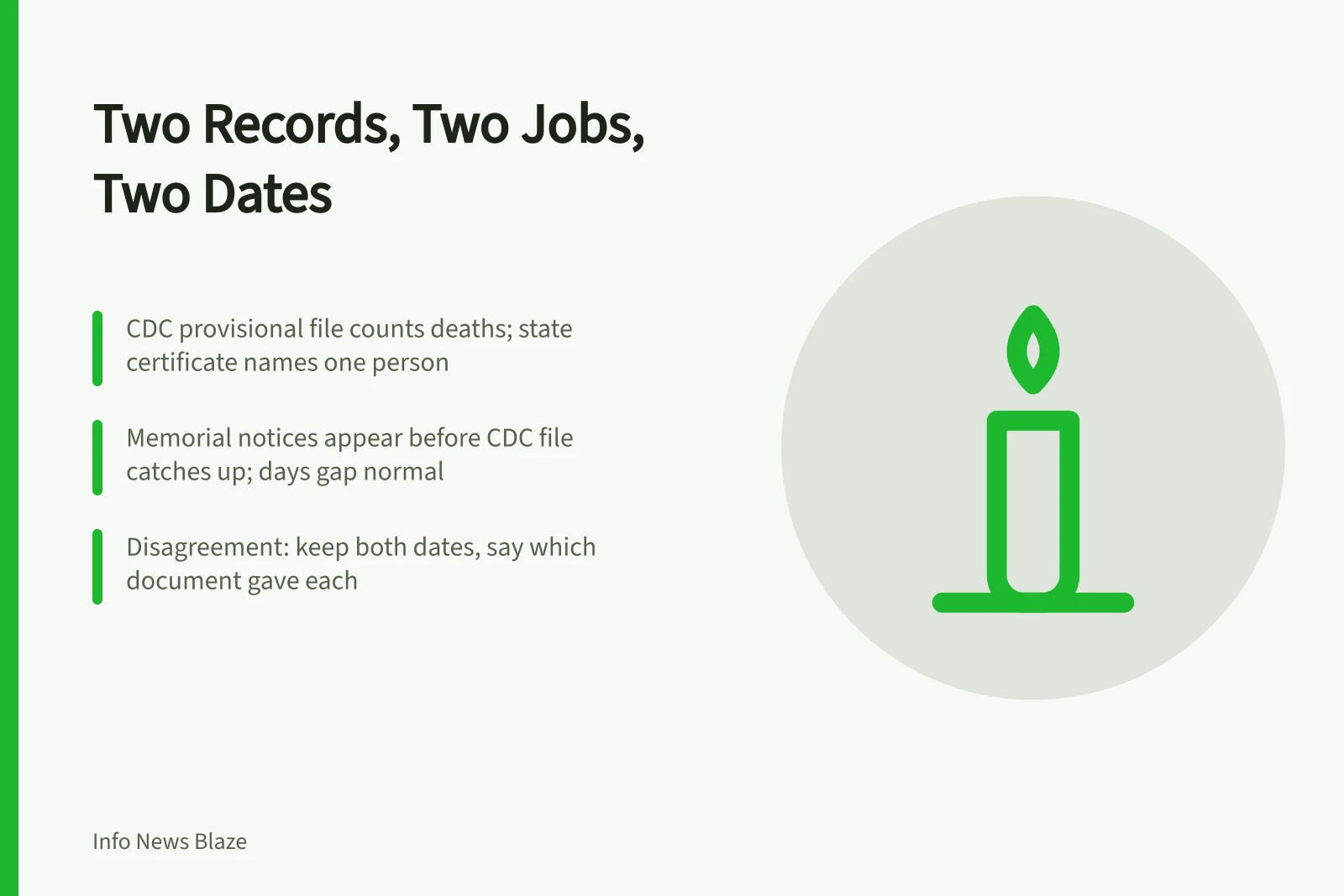
- A national mortality file counts deaths. A state death certificate names one person. An archive entry cites the document that matches the claim it makes.
- Local memorial notices usually appear before the CDC provisional file catches up. A gap of days is normal and not a contradiction.
- Two dated, independent sources are the bar for publication. One undated post is not a source.
- When the two records disagree, keep both dates and say which document gave each one.
Two records, two jobs
The National Center for Health Statistics builds the national mortality file from death certificates filed by the states. Early counts are provisional. Later revisions move the numbers, sometimes by a lot.
Three death records compared
CDC provisional data
- Timing
- Weeks after death
- Confirms
- Counts by cause
- Leaves out
- Individual names
State death certificate
- Timing
- Days to weeks
- Confirms
- Identity, date, cause
- Leaves out
- Access varies
Local memorial notice
- Timing
- Often within days
- Confirms
- Name, family, service
- Leaves out
- Cause, legal name
A memorial notice is a different artifact. A family, a funeral home, or a local news desk writes it. It carries a name, a date of death, and often a service time and a burial plan.
Neither document replaces the other. The national file is broad and slow. The local notice is narrow and fast, and it is usually the one that spells the name the way readers search for it.
The CDC handbook on mortality coding explains how a cause written by a physician becomes a coded category in that national file.
Ordering a certified copy starts at the state level, not with the federal government. The CDC keeps a page linking to each state vital records office.
| Record | Typical timing | What it confirms | What it leaves out |
|---|---|---|---|
| CDC provisional mortality data | Weeks after the death | Counts by cause, age, and place | Individual names |
| State death certificate | Days to weeks, varies by state | Identity, date, cause | Public access varies |
| Local memorial notice | Often within days | Name, family, service | Cause, in many cases |
| Coroner or medical examiner release | Days to months | Cause in some cases | Privacy limits apply |
Where the national file and a local notice disagree
Disagreement is common and usually dull. A notice says the death happened Tuesday. The certificate records a pronouncement at 12:20 a.m. Wednesday. Both are dated, and both are right about different events.
Spelling is the second pattern. A notice uses a stage name. The certificate uses a legal name. An entry should show the name readers search for and note the legal name once.
A third pattern is silence. A death appears in state records but no family notice is ever published. Private families and people with no next of kin listed produce this all the time.
A dated notice and a dated certificate can both be correct. The archive job is to say which one supports which sentence.
A three step check before an entry goes live
Three-step check before publishing
- Find the dated source
- Find a second independent dated source
- Write down each source's claims and disagreements
- Record the date you checked
Example: one name, two dates
A musician's death is reported on a Friday. The family notice says she died Thursday at home. The state file, checked weeks later, lists the date of death as Friday.
One death, two dated records
- ThursdayFamily notice says she died at home
- FridayDeath reported publicly
- FridayState file lists date of death
- Weeks laterState file checked and compared
An entry can hold both facts. It can state that the family notice gave Thursday and the state record gave Friday. What it should not do is pick one quietly and drop the other.
That is the method in one page. Keep the dates. Keep the sources. Let readers see the seam between them.
Reading a cause rumor in the first week
Cause rumors move fastest in the days before any document exists. Our guide on cause of death guides this week covers how a false explanation spreads and what a family can do. It fits here because a cause claim needs a document behind it, not a comment thread.
Premature obituaries are a documented genre, and a dated entry with a named source is the simplest way to avoid adding to them.
Local patterns: athletes, Atlanta, and Seattle
Sports deaths leave a distinct trail. Teams confirm, leagues confirm, and family notices follow within hours. Athletes who died today logs names, sports, and dates, and each entry waits for a confirming record before it appears.
Geography shapes which records surface first. Atlanta and Seattle notices compares how a film and music city and a tech city publish death notices at different speeds.
The running file itself is at deaths reported today, where every name carries the record behind it and a check on any name that arrives without one.